


Creating custom printed boxes for your business can seem overwhelming at first. You’re likely wondering about the right printing methods, materials, design requirements, and whether it’s worth investing in your own printing setup versus outsourcing. We’ll guide you through everything you need to know about printing custom boxes, from choosing materials to mastering different printing techniques and troubleshooting common issues.
Custom box printing is the process of applying designs, logos, text, and graphics directly onto packaging materials using various printing methods including flexographic, digital, offset, and screen printing to create branded packaging solutions.
TL;DR Summary:
• Box materials range from $0.30-$4.50 per unit with corrugated single-wall and coated paperboard offering the best value for most applications
• Flexographic printing dominates with 51% market share for corrugated boxes, while digital printing excels for runs under 500 units
• Industry-standard 300 DPI resolution ensures professional results with proper artwork preparation and color systems
• Manual screen printing setups start around $10,000 with ROI achievable within 1-2 years at consistent volume
• Registration tolerance, ink viscosity management, and proper pressure settings prevent common defects like smearing and misalignment
• Small orders cost $0.50-$1.50 per unit while large orders over 5,000 units reduce costs to $0.25-$0.70 per unit
• Water-based and soy-based inks provide eco-friendly options with easier recycling compared to solvent-based alternatives
• Thrive Screen Printing offers contract printing services with 24,000 items daily capacity and specialty finishes
Quick Tip: Start with a small test run of 100 units using digital printing to validate your design and substrate compatibility before committing to larger production runs—this approach saves money and prevents costly mistakes.
What Materials and Box Types Are Best for Custom Printing?
The best materials for custom printing include coated paperboard, corrugated substrates, and rigid boxboard, each offering distinct advantages for different applications and budgets. Material selection serves as the biggest cost lever for custom boxes, with substrate compatibility being critical for ink adhesion and print quality.
Which Box Substrates Are Most Suitable for Printing?
Box substrates most suitable for printing are linerboard, coated paperboard, corrugated substrates, and rigid boxboard materials. Linerboard holds 64% market share by material type as of 2023, making it the dominant choice for commercial printing applications.
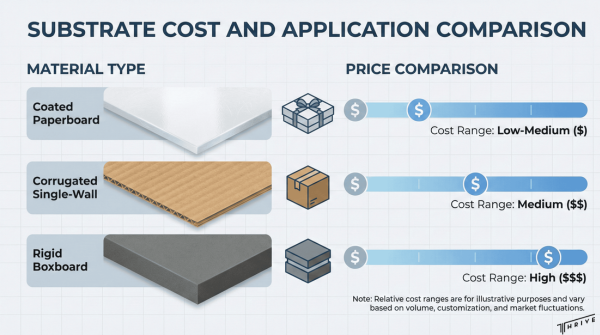
Cost comparison by substrate type:
| Substrate Type | Cost Range (1,000 units) | Best Applications |
| Coated Paperboard | $0.60-$1.80 | Gift boxes, cosmetic packaging |
| Corrugated Single-Wall | $0.80-$2.20 | Shipping boxes, e-commerce |
| Rigid Boxboard | $1.80-$4.50 | Premium packaging, luxury goods |
Substrate compatibility determines ink adhesion quality and overall print success. Coated paperboard provides the smoothest surface for detailed graphics, while corrugated materials require specialized inks for proper adhesion to textured surfaces. The substrate choice directly impacts both initial costs and long-term printing performance.
What Types of Custom Boxes Are Most Commonly Used?
The types of custom boxes most commonly used are slotted boxes, folding cartons, and multi-wall corrugated boards for transit applications. Slotted boxes dominate with 51% market share as of 2023, primarily due to their versatility and cost-effectiveness across industries.
Folding cartons represent 36.48% share of the printed rigid packaging market in 2024, particularly popular for retail and consumer goods. Double and triple-wall corrugated boards show significant growth in transit packaging applications where durability matters most.
Market distribution by industry:
- Food and beverage: 36% market share (largest segment)
- E-commerce shipping: fastest-growing segment
- Retail packaging: steady demand for folding cartons
- Industrial applications: multi-wall corrugated preference
E-commerce drives major growth in custom box demand, pushing innovations in design flexibility and quick-turnaround printing solutions. This section establishes the foundation for understanding which printing methods work best with these popular box types and materials.
What Printing Methods Can You Use for Custom Boxes?
Custom box printing methods include digital, offset, flexographic, and screen printing techniques. Each method offers distinct advantages for different production requirements, quality needs, and budget constraints. Understanding these printing technologies helps businesses choose the most cost-effective approach for their specific custom packaging projects.
How Do Digital, Offset, and Screen Printing Compare for Box Printing?
Flexographic printing dominates custom box production with 51% market share in corrugated box printing as of 2023. This printing method excels for high-volume runs due to its speed and cost-effectiveness at scale. A 2023 packaging industry report found flexographic setup costs average $800 for plates and proofs, making it economical for larger production volumes.
Digital printing equipment costs range from $10,000-$30,000 for startup businesses according to 2024 printing equipment surveys. Digital setup costs approximately $120 for artwork and RIP processing, significantly lower than other methods. This technology reduces make-ready time and enables on-demand production capabilities.
Offset printing delivers the highest quality results with photos and intricate graphics, particularly for litho-lam applications. Screen printing conforms well to textured and uneven corrugated surfaces while enabling specialty finishes. According to industry production studies, screen printing manual presses enable 100+ six-color prints per hour.
| Printing Method | Setup Cost | Equipment Cost | Best Application |
| Flexographic | $800 | $50,000-$500,000+ | High-volume runs (5,000+) |
| Digital | $120 | $10,000-$30,000 | Small runs (under 500) |
| Offset | $50-$300/plate | $100,000+ | High-quality graphics |
| Screen | Variable | $10,000+ | Specialty finishes |
These printing methods form the foundation for choosing the right approach based on volume, quality requirements, and budget constraints for custom box projects.
When Should You Choose Each Printing Technique for Custom Boxes?
The choice of printing technique depends on production volume, quality requirements, and turnaround time needs. Market growth data from 2024 industry analysis shows flexographic printing growing at 5.1% CAGR through 2030 due to cost-effectiveness at scale, while lithographic printing technology expects 5.7% CAGR from 2024-2030.
Small-Volume Applications:
- Digital printing works best for runs under 500 units
- Enables on-demand capability with faster turnaround
- Reduces waste from setup and make-ready processes
- Ideal for test markets and limited product launches
Large-Volume Production:
- Flexographic printing excels for runs over 5,000 units
- Minimal machine setup time maximizes production efficiency
- Cost per unit decreases significantly with volume
- Standard choice for established product lines
Specialty Applications:
- Screen printing works best for specialty finishes including foil, flock, gel, and high-density applications
- Handles textured substrates effectively
- Provides excellent opacity and color vibrancy
- Suitable for premium packaging requirements
Selection criteria should prioritize production volume as the primary factor, followed by quality requirements and delivery timeline considerations.
What Design Considerations Are Important for Printing Custom Boxes?
Design considerations for printing custom boxes focus on artwork preparation, color systems, and print quality optimization to achieve professional results. Proper file setup, color management, and finish selection directly impact both visual appeal and production costs.
How Do You Prepare Artwork and Layouts for Custom Box Printing?
Preparing artwork for custom box printing requires 300 DPI minimum resolution for high-quality results. Industry standards recommend 300-600 PPI for optimal output across different printing methods. Digital printing accepts 100 DPI minimum for basic applications, though higher resolution produces sharper text and graphics.
Registration tolerance varies by printing method and affects design precision. ISO 12647-6 standard requires register tolerance within 2÷linescreen for commercial printing. Digital printing achieves 1/100 inch accuracy, while flexographic screens typically operate at 100-150 lpi for corrugated applications. Offset printing delivers 200-1200 lpi equivalent detail for the finest graphics and photography.
Key artwork preparation steps include:
- Setting bleeds at 0.125 inches minimum beyond trim lines
- Converting fonts to outlines to prevent font substitution issues
- Using CMYK color mode rather than RGB for accurate color reproduction
- Creating die lines on separate layers for cutting templates
Proper file preparation prevents costly delays and ensures artwork translates accurately from screen to printed box.
What Color Systems and Finishes Work Best for Box Designs?
Color systems and finishes significantly impact both environmental footprint and production costs for custom boxes. Water-based inks reduce VOC emissions compared to solvent-based alternatives while maintaining vibrant color reproduction. Soy-based inks offer low VOCs with excellent color quality, and algae-based ink provides carbon-negative pigment as an eco-friendly option.
UV-curable inks eliminate VOC emissions entirely but require high heat and energy during curing. These inks work well for high-end applications requiring scratch resistance and durability.
Finish Options and Costs:
| Finish Type | Cost Per Unit | Best Applications |
| CMYK Printing | $0.30-$1.50 | Standard folding cartons |
| Lamination | $0.05-$0.50 | Moisture protection, durability |
| Foil Stamping | $0.25-$2.00 | Premium branding, accents |
| Embossing | $0.15-$1.00 | Texture, dimensional effects |
| Custom Inserts + Foil | $2.00-$5.00 | Luxury rigid boxes |
Color matching requires careful consideration of substrate and ink interaction. Coated substrates accept ink differently than uncoated corrugated, affecting final color appearance. Pantone matching systems ensure consistent brand colors across different production runs.
The combination of eco-friendly inks and cost-effective finishes helps businesses balance sustainability goals with budget constraints while achieving professional packaging results.
How Do You Set Up and Prepare for the Custom Box Printing Process?
Setting up for custom box printing requires careful equipment selection, workspace preparation, and quality control systems. Proper preparation reduces startup costs, minimizes waste, and ensures consistent print quality across production runs. The process involves selecting appropriate printing equipment, establishing registration standards, and implementing quality control measures.
What Tools and Equipment Do You Need to Print Custom Boxes at Home or in a Shop?
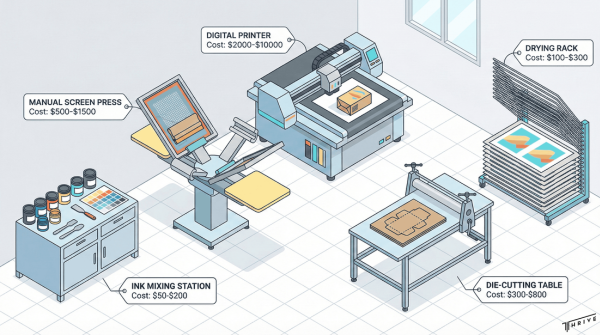
Equipment requirements for custom box printing vary significantly based on printing method and production volume. Manual screen printing press startup costs approximately $10,000 for basic equipment, making it accessible for small businesses and home operations. UV printing home setup ranges $12,000-$17,000 for functional operation, while flexographic printing machines cost $50,000-$500,000+ depending on complexity.
Essential tools include:
- Printing presses: Manual, semi-automatic, or fully automatic depending on volume
- Die-cut tooling: Costs $80-$500+ depending on complexity for custom box shapes
- Printing plates: Offset plates cost $50-$300 per plate for different colors
- Screen mesh: 280-305 mesh count works best for cardboard box printing applications
- Measuring equipment: Registration tools, color matching systems, and quality control instruments
Monthly equipment cost averages $212.47 at 10% interest over 5 years for small shops, making the investment manageable for growing businesses. The equipment selection directly impacts print quality, production speed, and long-term profitability.
How Do You Ensure Registration and Print Quality on Boxes?
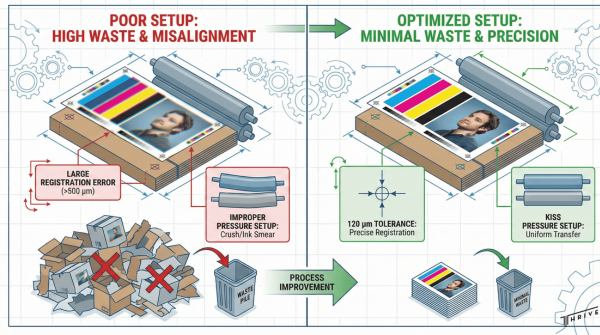
Registration and print quality control follow strict industry standards to ensure professional results. ISO 12647-6 specifies register tolerance at 120 lpi shall be ≤420 µm, should be ≤210 µm for optimal quality. ATIF Doc04 rates registration as good if ≤50 µm, sufficient if ≤100 µm, providing clear benchmarks for quality assessment.
Key quality control factors include:
- Ink management: Water-based ink viscosity window ranges 25-35 (Zahn #3) for corrugated substrates
- pH control: Target of 8.5-9.2 required for water-based inks to maintain consistency
- Pressure settings: Kiss impression pressure prevents dot gain and maintains print quality
- Equipment calibration: Anilox roller volume determines ink transfer consistency in flexographic printing
- Plate alignment: Mounting accuracy prevents skewing during print runs
Proper registration setup reduces make-ready waste and ensures color alignment across multiple print stations. These standards help achieve professional results comparable to commercial printing operations.
This comprehensive setup process prepares you for successful custom box printing, whether starting with basic equipment or investing in advanced systems. The next section covers practical step-by-step printing instructions to put this preparation into action.
What Are the Step-by-Step Instructions for Printing on Custom Boxes?
Printing custom boxes involves specific procedures that vary by printing method, each requiring precise execution to achieve professional results. The following sections detail practical application techniques and troubleshooting steps for successful custom box printing.
How Do You Apply Each Printing Method in Practice for Boxes?
Each printing method requires specific application procedures for optimal results on custom boxes. Flexographic printing demands daily cleaning of anilox rollers to prevent ink buildup that compromises print quality. Screen printing achieves superior results when substrates receive proper corona treatment to improve ink adhesion. Digital printing requires RIP processing and comprehensive color management setup before production begins.
Key operational steps include:
- Monitor ink viscosity continuously during flexographic runs to maintain consistency
- Control web tension precisely to prevent misregistration across multiple color layers
- Adjust drying temperature and airflow to prevent ink smearing and set-off issues
- Execute thorough machine cleaning post-print to eliminate ink buildup for future runs
These procedures ensure consistent print quality and equipment longevity across all printing methods. The following section explores troubleshooting when problems arise during production.
What Are Common Troubleshooting Steps When Printing Custom Boxes?
Common printing problems on custom boxes require specific troubleshooting approaches for quick resolution. Ink smearing issues need increased drying temperature or reduced ink volume to achieve proper curing. Pinholing problems require substrate surface treatment or reduced ink viscosity for smooth ink flow. Dot gain issues demand pressure reduction to kiss impression level for clean detail reproduction.
Additional troubleshooting solutions include:
- Re-register plates and adjust web tension to correct misregistration problems
- Switch to higher BCM anilox or add retarder to ink for ghosting elimination
- Reduce impression pressure and increase ink viscosity to resolve feathering
- Add retarder or modify design complexity when fine details fill in during printing
These troubleshooting steps address the most frequent issues encountered in custom box printing production. Implementing these solutions systematically resolves most print quality problems and maintains consistent output quality throughout production runs.
What Are the Pros, Cons, and Limitations of Printing Your Own Custom Boxes?
Printing custom boxes in-house offers significant cost advantages and creative control, but requires substantial upfront investment and technical expertise. The decision involves weighing equipment costs, volume requirements, quality expectations, and operational capabilities against outsourcing alternatives.
What Advantages and Challenges Should You Consider?
Small-volume printing costs $0.50-$1.50 per unit for orders of 100-500 units, while large orders of 2,000-50,000+ units reduce costs to $0.25-$0.70 per unit. Setup costs become negligible per unit at volumes over 5,000, making high-volume production economically viable.
Time constraints present both opportunities and challenges:
- Rush orders with 48-hour turnaround add 10-30% to standard costs
- Standard lead times typically require 2-4 weeks
- In-house production eliminates third-party scheduling delays
Financial performance metrics show promising returns. According to a 2023 packaging industry study, 85% of packaging businesses achieve ROI within 3-6 months with proper solutions. Manual presses can break even within 1-2 years at consistent volume, making them suitable for small to medium operations.
Key challenges include:
- High initial equipment investment ($10,000-$500,000+ depending on technology)
- Technical skill requirements for quality control
- Maintenance and consumable costs
- Storage space for materials and finished goods
This section prepares you to understand optimization strategies that minimize waste while maximizing production efficiency.
How Can You Maximize Results While Minimizing Cost and Waste?
Registration accuracy dramatically impacts material efficiency. Proper registration reduces make-ready waste from 200-300 sheets to 80-120 sheets, cutting waste by approximately 60% during setup.
Material optimization strategies include several practical approaches:
- Offcuts serve as internal dividers and protective inserts
- Print overruns supply e-commerce repack stations
- Automated width optimization reduces material waste significantly
Sustainability and recycling enhance long-term value. QR/DataMatrix labeling enables post-consumer sortation for recycling, supporting circular economy principles. Water-based and soy-based inks allow easier de-inking than solvent-based alternatives during recycling processes.
Material recyclability varies by substrate. Corrugated boxes offer full recyclability with fused material and fiber layers, making them environmentally preferable for many applications.
Cost reduction techniques:
- Batch similar jobs to minimize setup changes
- Maintain consistent substrate inventory to leverage bulk pricing
- Implement quality control systems to reduce reprints
- Schedule production during off-peak energy hours
These optimization approaches prepare businesses to evaluate whether in-house printing aligns with their operational goals and whether partnerships with established providers like Thrive Screen Printing might offer superior value.
How Should You Approach Printing Custom Boxes with Thrive Screen Printing?
Custom box printing requires professional expertise and specialized equipment to achieve optimal results. Thrive Screen Printing offers comprehensive solutions for businesses seeking high-quality custom packaging with advanced printing techniques and proven industry experience.
Can Thrive Screen Printing Help With Printing Custom Boxes?
Thrive Screen Printing can help with printing custom boxes through their comprehensive specialty printing services and extensive industry experience. Operating with 50+ employees since 1990, the company produces and ships 24,000 items daily, demonstrating proven capacity for large-scale custom printing projects.
The company’s services include:
- Contract screen printing with specialty finishes
- DTG (Direct-to-Garment) printing capabilities
- Advanced specialty applications covering flock, foil, gel, high-density, water-based, and metallic printing
- Licensed merchandise production expertise since establishment
Thrive serves diverse industries including private brands, entertainment, corporate events, bands, sports, education, and non-profits. Their rock-and-roll merchandise production experience since 1990 showcases their ability to handle complex branding requirements and specialty finishes essential for custom box applications.
Contact Thrive Screen Printing at (602) 607-2171 or info@thrivescreenprinting.com at 3050 S 44th St, Phoenix, AZ 85040 for custom box printing consultations. This established foundation positions them to handle custom packaging projects requiring specialty printing techniques and consistent quality output.
What Are the Key Takeaways About How to Print Your Own Custom Boxes We Covered?
The key takeaways about printing custom boxes reveal substantial market opportunities and technical considerations for successful implementation. The global corrugated boxes market reached USD 162.82 billion in 2023, projected to hit USD 230.64 billion by 2030, indicating strong demand for custom packaging solutions.
Market dynamics show significant regional concentration, with Asia Pacific holding 52% market share and China alone representing 29% share. North America’s corrugated and folding carton market valued at USD 37.27 billion in 2025, while US corrugated and paperboard boxes demand reached USD 47 billion in 2024.
The custom packaging segment specifically valued at USD 43.88 billion in 2023 is growing to USD 71.10 billion by 2032. Sustainable material-based packaging drives growing demand for corrugated solutions, aligning with environmental regulations and consumer preferences.
Real-world results demonstrate significant business impact, with one corrugated solutions provider achieving $450K in new sales with $6M+ annual potential through optimization strategies. These market indicators support investment in custom box printing capabilities and highlight the importance of choosing experienced partners like Thrive Screen Printing for professional implementation.

Robert Fisher is the founder and CEO of Thrive Screen Printing and brings extensive experience in the screen printing and fulfillment industry.