

For screen printers seeking the softest possible prints with excellent durability, discharge ink represents a game-changing technology that’s reshaping the custom apparel industry. We understand you’re weighing your ink options and need clear guidance on when discharge printing delivers superior results versus when traditional methods serve you better. Let’s demystify discharge ink and help you make the optimal choice for your next project.
Discharge ink is a water-based formulation containing zinc formaldehyde sulfoxylate (ZFS) or alternative bleaching agents that chemically remove existing dye from fabric fibers when heated to 320-330°F, allowing new pigments to bond directly with the fabric at a molecular level.
TL;DR Summary:
• Discharge ink contains ZFS (0.1-30% concentration) that removes fabric dye when heated, creating ultra-soft prints that last as long as the garment
• Works best on 100% cotton, bamboo, and hemp fabrics with reactive dyes; delivers fair results on cotton/poly blends but fails on 100% polyester
• Excels for premium workwear, multicolor designs, and fashion brands requiring soft-hand feel with excellent wash fastness (4-5 rating)
• Avoid discharge on non-reactive dyed garments, polyester fabrics, or when production speed matters most (50 vs 110 garments/hour for plastisol)
• Requires proper ventilation, gas-fired dryers, and water-resistant screens; curing at 320-330°F for 90+ seconds eliminates telltale smoke
• Outperforms plastisol and water-based inks for breathability and hand feel while maintaining durability equal to plastisol
• Test fabric compatibility first, budget for slower production speeds, and communicate vintage effects on blended fabrics to customers
• Thrive Screen Printing in Phoenix specializes in discharge techniques with pricing from $3.50-$2.20 per unit and comprehensive fabric testing
Quick Tip: Always request a fabric sample test before committing to discharge printing on blended materials—the cotton portion will discharge while polyester remains unchanged, creating a distinctive vintage effect that customers either love or need to understand upfront.
The global discharge inks market, valued at USD 146.18 billion in 2024 and projected to reach USD 282.83 billion by 2032, reflects growing demand for sustainable, soft-hand printing methods that deliver premium results without compromising durability.
What Is Discharge Ink and How Does It Work in the Screen Printing Process?
Discharge ink is a water-based printing solution that removes fabric dyes through chemical bleaching agents, creating soft, breathable prints that bond directly with fabric fibers. Unlike traditional inks that sit on fabric surfaces, discharge inks work by eliminating existing dyes and replacing them with new colors during the curing process.

This printing method offers superior hand feel and durability compared to plastisol or standard water-based inks. The following sections explore the specific ingredients that enable discharge printing and how this process differs from conventional screen printing methods.
What Ingredients Make Up Discharge Ink?
Discharge ink contains zinc formaldehyde sulfoxylate (ZFS) as the primary bleaching agent, typically used at concentrations between 0.1-30% by weight. Water-based formulations include specific bleaching compounds that activate when heated to 320-330°F, breaking down dye molecules at the molecular level.
Eco-friendly alternatives such as thiourea dioxide provide formaldehyde-free options for environmentally conscious operations. ZFS requires fresh mixing and maintains optimal effectiveness for only 6-8 hours after preparation, making timing critical for production schedules.
How Does Discharge Ink React with Fabric Compared to Plastisol or Water-Based Inks?
Discharge ink creates molecular-level bonds with fabric fibers, producing prints that last as long as the garment itself with excellent wash-fastness ratings of 4-5 on a 1-5 scale. The process achieves a “very soft” hand feel compared to “soft” for water-based inks and “heavy” for plastisol applications.
This method provides excellent breathability while reducing water consumption by up to 90% compared to traditional dyeing processes. Discharge printing works best on reactive-dyed fabrics, delivering good color vibrancy and exceptional durability for premium applications.
The next section examines when discharge ink becomes the optimal choice for custom apparel projects.
When Is Discharge Ink the Best Choice for Custom Apparel Printing?
Discharge ink serves as the optimal choice for custom apparel printing when fabric compatibility, design requirements, and quality expectations align with its unique properties. This printing method excels in specific scenarios while offering distinct advantages over traditional plastisol and water-based alternatives.
The following sections examine fabric compatibility, design applications, and key advantages to help determine when discharge ink delivers superior results for your printing projects.
On Which Types of Fabrics Does Discharge Ink Perform Best?
Discharge ink performs best on 100% cotton fabrics with reactive dyes, showing excellent discharge results that create vibrant, long-lasting prints. Natural fiber alternatives such as bamboo and hemp fabrics demonstrate excellent compatibility with discharge agents, producing soft-hand prints with superior durability.
Cotton/polyester blends produce fair to good results with distinctive vintage effects, as only the cotton portion responds to discharge while polyester fibers remain unchanged. Garments specifically manufactured for discharge printing provide the most effective foundation, ensuring consistent results and optimal color removal.
Fabric Performance Rankings:
- 100% cotton with reactive dyes: Excellent
- Bamboo and hemp fabrics: Excellent
- Cotton/polyester blends: Fair to good (vintage effects)
- Discharge-ready garments: Most effective
What Kinds of Designs and Effects Benefit Most from Discharge Printing?
Designs benefit most from discharge printing when they require multicolor applications using Fusion Pigments at 10-20% pigment load, enabling wet-on-wet printing without flashing between colors. Non-dischargeable ink underlays create unique textured effects that combine the soft feel of discharge with added visual depth.
Workwear applications particularly benefit from discharge’s comfortable, durable branded prints with an exceptionally soft feel that maintains professional appearance through repeated washing. Premium fashion brands increasingly adopt discharge printing for its superior quality and comfort compared to traditional screen printing methods.
Optimal Design Applications:
- Multicolor designs with wet-on-wet capabilities
- Textured effects using ink underlays
- Professional workwear branding
- Premium fashion applications

What Are the Main Advantages of Using Discharge Ink?
Discharge ink achieves excellent wash fastness ratings of 4-5 on a 1-5 scale and superior rub fastness due to molecular-level fiber bonding that eliminates surface buildup. Light fastness ratings of 5-6 on a 1-8 scale make discharge suitable for drapes and display fabrics requiring UV resistance.
According to textile testing standards, discharge demonstrates perspiration fastness of 4+ on a 1-5 scale, making it ideal for sportswear and athleisure applications. The process eliminates harmful solvents and PVCs compared to traditional plastisol inks, supporting environmentally conscious printing practices.
Performance Advantages:
- Wash fastness: 4-5/5 scale
- Light fastness: 5-6/8 scale
- Perspiration fastness: 4+/5 scale
- Eliminates PVCs and harmful solvents
Discharge ink represents the premium choice when fabric compatibility, design complexity, and durability requirements justify its specialized application process and equipment needs.## When Should You Avoid Using Discharge Ink for Printing?
Discharge ink presents specific limitations that make it unsuitable for certain fabrics, production scenarios, and durability requirements. Understanding these constraints helps screen printers choose the right ink technology for optimal results and cost-effectiveness.
The following sections detail fabric incompatibilities, production limitations, and durability considerations that determine when alternative ink types provide better solutions for custom apparel projects.
What Fabrics or Garment Colors Are Unsuitable for Discharge Ink?
100% polyester shows poor results as it remains unaffected by the discharge process. Polyester fibers resist chemical breakdown, making discharge agents ineffective at removing synthetic dyes or creating the soft-hand feel associated with discharge printing.
Polyester in blends remains unchanged, with only the cotton portion discharging properly. Cotton/polyester blends create unpredictable vintage effects where the cotton discharges while polyester retains its original color and texture.
Key fabric limitations include:
- Garments not dyed with reactive dyes may not discharge properly
- Fabrics with special finishes or coatings interfere with discharge reaction
- Synthetic blends above 50% polyester show diminished results
- Pre-treated or moisture-wicking fabrics resist discharge chemistry
What Are the Most Common Issues or Limitations with Discharge Printing?
Production speed reduces to 50 garments/hour versus 110 for plastisol on entry-level equipment. High-production dryers achieve 900 discharge garments/hour compared to 2,700 for plastisol, significantly impacting throughput for large orders.
Discharge printing requires gas-fired forced-air dryers to exhaust fumes properly. Improper curing creates billowing smoke indicating incomplete process, while proper curing eliminates visible smoke emissions during the drying cycle.
Additional operational challenges:
- Longer curing times at 320-330°F for 90+ seconds
- Water-resistant emulsion screens required for setup
- Limited working time of 6-8 hours after mixing ZFS
- Higher ventilation and safety equipment costs

How Does Discharge Ink Affect Durability and Longevity Compared to Other Inks?
Discharge achieves “excellent” durability rating equal to plastisol through molecular-level fiber bonding. Water-based inks show “good” durability compared to discharge’s “excellent” performance in wash testing protocols.
Dry rub fastness achieves 4+ rating on a 1-5 scale for upholstery and outerwear applications. Wet rub fastness maintains 3-4+ rating suitable for heavy-use applications including workwear and athletic garments.
| Ink Type | Durability Rating | Dry Rub Fastness | Wet Rub Fastness |
| Discharge | Excellent | 4+ | 3-4+ |
| Plastisol | Excellent | 4-5 | 4-5 |
| Water-based | Good | 3-4 | 3 |
Despite excellent durability, discharge ink’s color vibrancy rates “good” compared to plastisol’s “excellent” brightness, limiting its effectiveness for designs requiring vibrant, bold colors.
This analysis of discharge ink limitations prepares you to evaluate water-based and plastisol alternatives that may better serve specific project requirements and production constraints.## How Do You Prepare Artwork and Set Up for Discharge Printing Successfully?
Preparing artwork and setting up for discharge printing requires specific technical considerations that differ significantly from plastisol or water-based printing approaches. Discharge printing demands precise file preparation, specialized screen setup, and strict adherence to safety protocols to achieve optimal results.
This section explores the essential file preparation techniques, screen setup requirements, and safety considerations that ensure successful discharge printing operations. Each aspect directly impacts print quality, production efficiency, and workplace safety.
What Are the Key File Preparation Tips for Discharge Ink Jobs?
The key file preparation tips for discharge ink jobs include two primary printing methods and specific design considerations for fabric interaction. Discharge printing requires careful planning to account for the chemical reaction between discharge agent and fabric dyes.
Two primary methods are available for discharge printing:
- Individual Color Method: discharge agent mixed directly into each ink color
- Underbase Method: discharge base applied first, followed by overprinting with pigmented inks
Designs must account for vintage effects on cotton/polyester blends where only the cotton portion discharges, creating intentional faded appearances. Color separation requires understanding how discharge interacts with base fabric colors, as the final result depends on both the original dye and the discharge reaction intensity.
File preparation should specify which fabric portions will discharge and which will remain unaffected, particularly important for polyester blend garments where synthetic fibers resist discharge treatment.
What Special Steps Must You Take During Screen Preparation and Printing?
Special steps during screen preparation and printing focus on temperature control, emulsion selection, and moisture elimination. Discharge printing requires precise curing parameters and specialized screen materials to handle water-based formulations effectively.
Water-resistant emulsion screens are required for discharge printing to prevent breakdown from the water-based ink system. Standard emulsions designed for plastisol may fail when exposed to discharge formulations containing zinc formaldehyde sulfoxylate and water.
Curing requires 320-330°F for 90+ seconds in conveyor dryers to activate the discharge reaction completely. Water must be completely driven from the ink during the curing process to prevent incomplete discharge and poor wash fastness.
The absence of smoke billowing from the dryer indicates proper curing, while visible smoke suggests incomplete water evaporation or insufficient temperature. Gas-fired forced-air dryers work best for exhausting discharge fumes properly during the curing process.
What Safety and Environmental Considerations Apply When Using Discharge Ink?
Safety and environmental considerations center on zinc formaldehyde sulfoxylate (ZFS) handling and regulatory compliance standards. Discharge printing involves chemicals that require specific protective equipment and ventilation systems to maintain workplace safety.
ZFS irritates skin, lungs, and eyes, making proper ventilation the most critical safety precaution in discharge operations. Class III respirators are required when mixing or handling discharge agents to prevent inhalation of potentially harmful particles.
OSHA compliance focuses on three primary areas:
- Hazard Communication: proper labeling and safety data sheets for all discharge chemicals
- Lockout/Tagout: securing equipment during maintenance and cleaning procedures
- Machine Guarding: protecting operators from moving parts during printing operations
OEKO-TEX® STANDARD 100 certification tests for 1,000+ harmful substances in finished textiles, ensuring discharge-printed garments meet international safety standards. ISO 14184 provides the international standard for formaldehyde determination in textiles, helping manufacturers verify compliance with formaldehyde limits.
Understanding these preparation requirements helps screen printers achieve consistent discharge results while maintaining safe working conditions and regulatory compliance throughout the production process.
How Does Discharge Ink Compare to Water-Based and Plastisol Inks for Different Uses?
Discharge ink compares favorably to traditional inks in specific applications, particularly where fabric hand feel and breathability are priorities. Each ink type serves distinct purposes based on project requirements, fabric types, and production goals.
In Which Scenarios Does Discharge Outperform Traditional Inks?
Discharge ink outperforms traditional inks in premium applications requiring superior comfort and environmental benefits. Discharge achieves a “very soft” hand feel compared to water-based’s “soft” rating or plastisol’s “heavy” texture, making it ideal for high-end garments where comfort matters most.
The breathability advantage of discharge proves significant for activewear and workwear applications. While discharge provides excellent breathability, plastisol offers poor breathability, creating uncomfortable wearing experiences in warm conditions. This makes discharge the preferred choice for athletic apparel and outdoor work clothing.
Environmental impact represents another key advantage, with discharge reducing water consumption by 90% compared to traditional dyeing methods. This reduction appeals to eco-conscious brands and helps manufacturers meet sustainability targets without sacrificing print quality.
Premium workwear applications benefit most from discharge’s unique combination of comfort and durability, delivering excellent durability ratings equal to plastisol while maintaining the soft feel that workers prefer during long shifts.
When Do Water-Based or Plastisol Inks Offer a Better Solution than Discharge?
Water-based and plastisol inks excel in scenarios where color vibrancy, production speed, or environmental impact take priority over hand feel. Plastisol delivers “excellent” color vibrancy compared to discharge’s “good” rating, making it essential for designs requiring bold, saturated colors or specific Pantone matches.
Production efficiency favors plastisol and water-based options significantly. Plastisol processes 110-2,700 garments per hour compared to discharge’s 50-900 garments on comparable equipment, making it crucial for high-volume orders with tight deadlines.
Water-based inks achieve an “excellent” environmental rating versus discharge’s “good” rating, particularly when formaldehyde-free formulations are required. Though water-based produces “muted” colors, its excellent environmental profile suits brands prioritizing sustainability over color intensity.
Cost-sensitive projects often benefit from plastisol’s proven efficiency and lower setup requirements, while water-based offers compromise between environmental responsibility and production practicality for medium-volume runs.
This comparison reveals that ink selection depends heavily on balancing comfort, environmental impact, color requirements, and production constraints for each specific project.
How Should You Decide Which Ink Type Is Best for Your Project?
Choosing the best ink type requires evaluating equipment effectiveness, target margins, fabric compatibility, and cost implications across your specific printing operation. Consider your production volume, fabric types, and quality expectations when selecting between discharge, plastisol, and water-based inks.
What Questions Should You Ask Before Choosing Discharge Ink?
The questions to ask before choosing discharge ink focus on operational metrics, financial targets, timeline expectations, and growth projections for your printing business.
Key Performance Questions:
- Overall Equipment Effectiveness (OEE) measures the percentage of time your press produces saleable product
- Can you achieve a target gross margin of 80% or higher with proper ink selection?
- Are you prepared for a breakeven period of approximately 14 months for discharge printing operations?
- Does your business plan include EBITDA growth potential of $156K by Year 2 with efficient operations?
Production Capacity Assessment:
- What is your current daily production volume (1-50, 50-500, or 500+ units)?
- Do you have gas-fired forced-air dryers capable of 320-330°F curing temperatures?
- Can your facility handle the ventilation requirements for discharge ink fumes?
These questions help determine whether discharge ink aligns with your operational capabilities and financial objectives. The 14-month breakeven period requires careful cash flow planning, while the 80% gross margin target depends on efficient production processes and proper equipment utilization.
How Can You Test or Sample Inks to Ensure the Right Outcome?
Testing and sampling inks ensures compatibility with your specific fabrics and confirms expected results before committing to full production runs.
Fabric Compatibility Testing Results:
- 100% cotton and bamboo/hemp fabrics show excellent results in compatibility testing
- Cotton/polyester blends demonstrate fair to good results requiring sample testing
- 100% polyester consistently shows poor results in testing
- Test runs are recommended for verifying discharge effectiveness on specific garment dyes
Sample Testing Process:
- Request fabric samples from your garment supplier
- Conduct small-batch discharge tests on each fabric type
- Evaluate color discharge effectiveness, hand feel, and cure quality
- Document results for different dye types and fabric compositions
Cotton/poly blends require particular attention during sampling because the polyester fibers remain unchanged while only the cotton portion discharges, creating vintage effects that may or may not suit your design goals.
This systematic testing approach prevents costly production errors and ensures customer satisfaction with the final printed products. Sample testing becomes especially critical when working with new fabric suppliers or unfamiliar garment dyes.
What Else Should You Consider Before Selecting Discharge Ink for Your Order?
Selecting discharge ink involves cost implications and customer expectations that directly impact project success. Beyond technical compatibility, understanding equipment investments and market trends helps ensure your discharge printing decisions align with business goals and customer satisfaction.
What Are the Cost Implications and Production Considerations?
Cost implications for discharge ink vary significantly by operation scale and equipment requirements. Small operations processing 1-50 units daily require $200-$1,500 equipment investment, while medium operations handling 50-500 units need $3,000-$15,000 investment. Large operations processing 500+ units daily require $50,000-$100,000+ investment for professional-grade equipment.
Production capacity differs markedly between equipment levels. Entry-level Vastex D-100 dryers with 18″ belts process 50 discharge garments per hour, suitable for smaller operations. Professional automatic presses range from $4,895 to $100,000+, offering higher throughput for larger production volumes.
Equipment investment directly correlates with production efficiency and unit economics. Higher-capacity equipment reduces per-unit processing costs while increasing initial capital requirements. Consider your projected volume, timeline requirements, and budget constraints when evaluating discharge printing equipment investments.
What Customer Expectations Should Be Addressed Upfront?
Customer expectations around discharge printing reflect growing market demand for sustainable, soft-hand printing methods. The global discharge inks market reached USD 146.18 billion in 2024, with projections of USD 282.83 billion by 2032 representing 8.60% compound annual growth rate (CAGR).
Screen printing inks market growth from USD 4.68 billion to USD 6.57 billion reflects 3.12% CAGR, while the broader textile printing market expands from USD 25.8 billion to USD 27.9 billion by 2025. Consumer preference continues shifting toward soft-hand, sustainable printing methods that discharge ink provides.
Address timeline expectations early, as discharge printing requires longer curing cycles and specialized equipment compared to plastisol. Educate customers about the superior hand feel and durability benefits while setting realistic production schedules. This market growth indicates strong customer acceptance when expectations align with discharge printing capabilities.
The considerations for discharge ink selection extend beyond immediate technical requirements to encompass long-term business planning and customer relationship management for successful project outcomes.
How Can Thrive Screen Printing Help You Choose the Right Ink for Your Apparel?
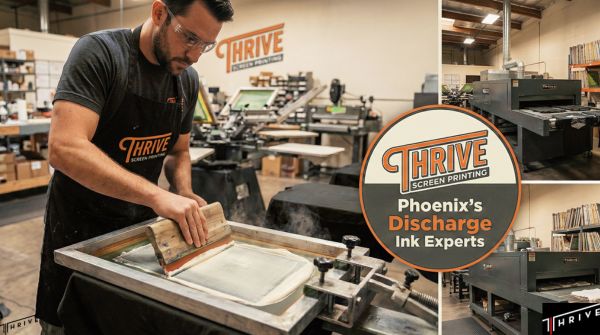
Thrive Screen Printing provides expert guidance and advanced discharge printing services to help clients select the optimal ink solution for their custom apparel projects. Based in Phoenix, Arizona, this nationally recognized provider specializes in matching ink technologies to specific fabric types, design requirements, and production goals. The following sections detail how Thrive’s expertise and comprehensive testing approach ensure exceptional results for every project.
Can Thrive Screen Printing Advise or Produce Exceptional Results with Discharge Ink?
Thrive Screen Printing operates as a nationally recognized provider based in Phoenix, Arizona, specializing in advanced discharge techniques for soft prints. The company serves diverse clients including tech startups, corporate accounts, and major events such as the Phoenix Pride Festival. Pricing ranges from $3.50-$2.20 per unit in Phoenix markets, with rates decreasing based on order volume and complexity.
Thrive conducts comprehensive fabric testing for optimal results on each project. This testing process evaluates fabric composition, dye compatibility, and discharge effectiveness before production begins. The company’s expertise extends to:
- Advanced discharge formulations for superior hand feel
- Color matching and pigment integration techniques
- Production optimization for various order sizes
- Custom solutions for specialty fabric requirements
What Are the Key Takeaways About When To Use Discharge Ink (And When Not To) We Covered?
The discharge printing market shows significant growth potential, valued at USD 47M with substantial expansion projected across multiple sectors. Formaldehyde-free alternatives are expanding market appeal and improving sustainability profiles for environmentally conscious brands.
Industry consolidation continues as larger manufacturers acquire specialty discharge producers, creating economies of scale that benefit end users. Key market trends include:
- Workwear, event merchandise, and fashion brands increasingly adopting discharge printing
- Economies of scale achieved at higher volumes with per-unit costs decreasing significantly
- Growing demand for soft-hand printing solutions in premium apparel
- Enhanced focus on sustainable printing methods across the textile industry
These market dynamics position discharge ink as a valuable option for projects requiring superior comfort, durability, and environmental responsibility. Thrive Screen Printing’s expertise helps navigate these considerations to deliver optimal results for each client’s specific requirements.

Robert Fisher is the founder and CEO of Thrive Screen Printing and brings extensive experience in the screen printing and fulfillment industry.