


If you’re researching screen printing registration systems in Phoenix, you’re likely facing challenges with print alignment, color accuracy, or production efficiency in Arizona’s demanding climate. Whether you’re starting a new print shop or upgrading existing equipment, understanding how registration systems perform in Phoenix’s unique environment is crucial for making the right investment. We’ll guide you through everything you need to know about choosing and optimizing registration systems for success in the Valley of the Sun.
Screen printing registration systems are specialized equipment and techniques that ensure precise alignment of multiple color layers during the printing process, critical for producing sharp, professional-quality prints on textiles and other substrates. These systems range from manual pin-based setups costing around $200 to sophisticated optical registration systems exceeding $100,000, each offering different levels of accuracy, speed, and automation to meet varying production needs.
TL;DR Summary: Screen printing registration systems ensure accurate multi-color alignment through manual, pin-based, or optical technologies. Manual systems cost $200-$2,000 and produce 40-100 prints/hour, while automatic systems range from thousands to over $100,000 but deliver 500-800 prints/hour. Phoenix’s extreme climate creates unique challenges—dust storms contaminate inks, low humidity affects screen tension, and temperature swings impact ink viscosity—requiring climate control and filtration systems. Local suppliers like Advanced Screen Print Supply and ScreenPrinting.com provide equipment and support, while compliance with OSHA, EPA, and ISO standards ensures safe operations. Thrive Screen Printing exemplifies local expertise in navigating these challenges while delivering high-quality custom apparel.
Quick Tip: Before investing in any registration system, test your shop’s climate control capabilities during Phoenix’s monsoon season (July-September) when humidity spikes dramatically—this period reveals whether your environment can maintain the stable conditions required for consistent registration accuracy.
How Do Screen Printing Registration Systems Work?
Screen printing registration systems work by precisely aligning multiple screens to create accurate, professional multi-color prints. These systems eliminate color misalignment through mechanical or optical positioning methods that ensure each color layer prints exactly where intended.
The registration process involves three critical components: screen positioning mechanisms, alignment reference points, and repeatability controls. Manual systems rely on physical guides and operator skill, while automatic systems use computerized positioning for consistent results. Both approaches aim to achieve the tight tolerances required for professional screen printing. The following sections explore the main system types, alignment processes, and common accuracy challenges that Phoenix screen printers encounter.
What Are the Main Types of Screen Printing Registration Systems?
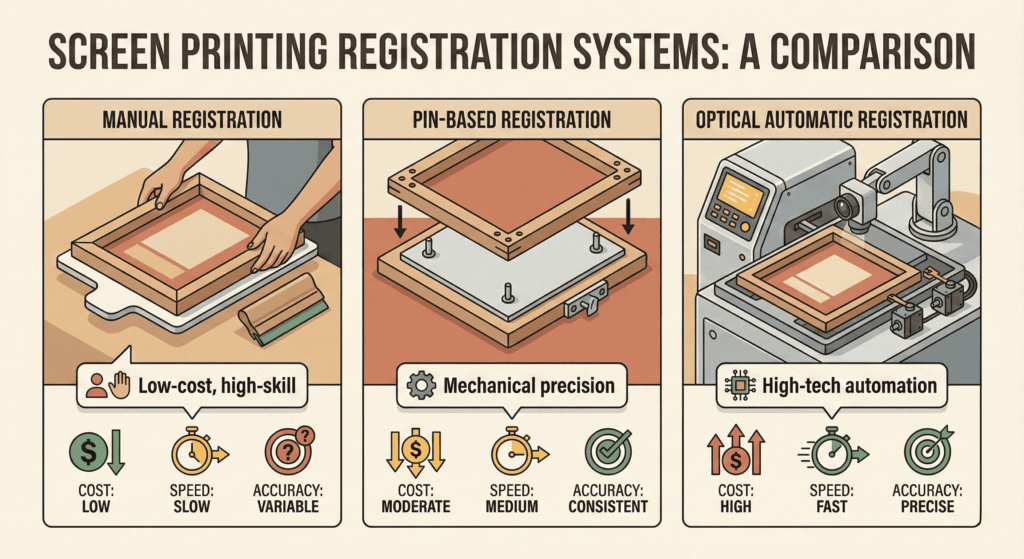
The main types of screen printing registration systems are manual, automatic, pin-based, and optical systems, each offering different levels of precision and production speed.
Manual registration systems cost from $200 for basic kits and produce 40-100 prints per hour. These entry-level systems require skilled operators to achieve consistent alignment through visual positioning and physical guides. Automatic registration systems range from a few thousand to over $100,000 and produce 500-800 prints per hour with minimal operator intervention.
Pin registration systems like Vastex VRS and M&R Tri-Loc use pins on a registration board and pallet jig to align screens mechanically. Optical registration systems use cameras and servo motors to achieve accuracy of ±0.001 inches or 0.025 mm. Systematic Automation’s optical system uses RGB optical laser technology to detect registration marks and automatically adjust screen position for maximum precision.
| System Type | Cost Range | Production Rate | Accuracy | Operator Skill |
| Manual | $200-$2,000 | 40-100/hour | ±0.010″ | High |
| Pin Registration | $1,000-$10,000 | 100-300/hour | ±0.005″ | Medium |
| Optical Automatic | $50,000-$100,000+ | 500-800/hour | ±0.001″ | Low |
How Does the Registration Process Ensure Print Alignment?
The registration process ensures print alignment through systematic positioning methods that create repeatable reference points for each color layer.
Pin registration involves aligning film positives on layout grids, punching registration holes, and using pins for consistent placement across all screens. This mechanical approach creates physical reference points that operators can rely on for accurate positioning. Optical systems automatically align screens to pre-printed marks using camera detection and servo motor adjustments.
High-end systems achieve registration accuracies of ±0.001 inches through computerized positioning controls. Manual systems depend on operator skill and experience, while automatic systems offer consistent repeatability regardless of operator expertise. A 2019 study on registration accuracy found that optical systems reduced registration errors by 87% compared to manual alignment methods.
What Common Issues Affect Screen Registration Accuracy?
Common issues affecting screen registration accuracy include environmental factors, equipment limitations, and material inconsistencies that disrupt precise alignment.
Phoenix’s low humidity can cause screens to swell during monsoon season, affecting mesh tension and registration stability. Extreme summer heat causes inks to dry quickly on screens, leading to screen clogging and uneven ink deposits. Cold winter temperatures make inks thicker and more difficult to print consistently.
Dust storms (haboobs) introduce PM10 particulate matter that can contaminate inks and clog screen mesh. A 2025 study documented significant short-term PM10 concentration spikes during convective dust events in the Greater Phoenix Area, directly impacting print shop air quality. Equipment wear, inconsistent substrate thickness, and improper screen tensioning also contribute to registration problems that require constant monitoring and adjustment.
This registration accuracy foundation supports the critical role these systems play in maintaining print quality standards and production efficiency for Phoenix screen printing operations.
Why Is Accurate Registration Critical for Screen Printing Projects?
Accurate registration is critical for screen printing projects because it ensures precise color alignment, maintains print quality, and maximizes production efficiency. Registration directly impacts the final product’s visual appeal and durability, especially in Phoenix’s challenging environmental conditions.
How Does Misregistration Impact Print Quality?
Misregistration impacts print quality by creating color separation, visual defects, and reduced durability. Phoenix’s extreme temperatures exacerbate these issues by causing colors to separate and run during the printing process. Inks harden quickly in high heat and become brittle, leading to cracking, peeling, and fading over time.
Tighter error margins produce higher quality prints with significantly less material waste. Misaligned colors create blurred edges, ghosting effects, and unprofessional appearances that reduce customer satisfaction and brand reputation.
What Strategies Help Prevent Registration Errors?
The most effective strategies for preventing registration errors include:
- Pin registration systems that significantly reduce on-press registration time compared to manual alignment by eye
- Automatic systems with optical alignment that reduce labor requirements to only loading and unloading substrates
- Excellent air filtration and dust control measures that Phoenix shops require to mitigate contamination from dust storms and particles
These prevention strategies work together to maintain consistent registration accuracy throughout production runs, especially during Phoenix’s monsoon season when humidity fluctuations affect screen stability.
Why Is Registration Especially Important for Multi-Color Prints?
Registration is especially important for multi-color prints because each color layer must align precisely with others to create the intended design. Registration systems are critical for achieving accurate multi-color prints where even minor misalignment becomes immediately visible.
Manual systems require highly skilled operators to achieve accuracy levels comparable to automatic systems. Production speed metrics demonstrate this difference: automatic presses produce 500 prints per hour with two employees versus 60 prints per hour with one employee for manual systems.
Multi-color designs amplify registration errors exponentially—what appears as a minor shift in single-color work becomes a major defect when multiplied across three to six color separations. This section prepares the foundation for understanding how Phoenix’s unique environmental factors further complicate registration challenges in desert conditions.
What Local Environmental or Operational Factors in Phoenix Affect Screen Printing Registration?
Local environmental and operational factors in Phoenix significantly impact screen printing registration accuracy through climate extremes, equipment requirements, and regulatory compliance needs. Phoenix’s unique desert environment creates specific challenges that screen printers must address to maintain consistent registration quality.
How Does Phoenix’s Climate Influence Print Registration?
Phoenix’s climate directly affects print registration through extreme humidity variations and atmospheric conditions. Phoenix experiences very low humidity most of the year, with significant increases during summer monsoon season that can cause screens to swell and lose tension accuracy.
High humidity during monsoon season slows drying of water-based inks and affects emulsion exposure timing, requiring adjustments to standard registration procedures. A 2025 study documented significant short-term PM10 concentration spikes during convective dust events in the Greater Phoenix Area, introducing particulate contamination that can interfere with optical registration systems.
Phoenix sits at an average elevation of 1,086 feet, where altitude changes can affect ink viscosity and chemical performance compared to sea-level specifications. Temperature extremes between summer heat exceeding 115°F and winter lows below 40°F require registration systems to compensate for thermal expansion and contraction of both screens and substrates.
What Role Does Shop Setup and Equipment Play in Registration Precision?
Shop setup and equipment selection directly determine registration precision through environmental control and contamination management. Climate control systems are essential to manage temperature and humidity fluctuations that affect screen tension, ink consistency, and substrate dimensions.
Air filtration systems must handle dust storms (haboobs) that introduce contaminants into the printing environment, potentially clogging screens and interfering with optical registration sensors. Equipment choice impacts ROI significantly, with automatic presses offering better returns through higher production speeds of 500-800 prints/hour despite higher initial costs compared to manual systems producing 40-100 prints/hour.
Professional Phoenix shops require HEPA filtration, sealed printing areas, and climate monitoring systems to maintain the stable conditions necessary for consistent registration accuracy within ±0.001 inch tolerances.
Are There Phoenix-Specific Compliance or Industry Standards for Registration?
Phoenix screen printing operations must comply with federal safety and environmental standards that affect registration system implementation. OSHA requires Hazard Communication (HazCom) for chemical handling and Lockout/Tagout (LOTO) for machine maintenance, impacting how registration equipment is operated and serviced.
EPA regulates disposal of hazardous waste and emissions from printing facilities, affecting ventilation requirements around registration stations. ISO 12647-5:2015 provides specific standards for screen printing covering color accuracy, transparency, and tone value increase that registration systems must achieve.
Machine guarding requirements prevent injuries from moving parts in automatic registration systems, requiring safety interlocks that can affect system speed and accessibility. Arizona’s extreme temperature regulations may require additional cooling systems around sensitive registration equipment to maintain OSHA workplace temperature standards.
This foundation of environmental challenges and compliance requirements sets the stage for understanding how Phoenix businesses select appropriate registration systems based on their specific operational needs and production volumes.
What Are the Most Popular Registration Systems Used by Phoenix Screen Printers?
Phoenix screen printers primarily rely on manual pin registration systems and automatic optical systems, with brand preferences centered around M&R and Vastex equipment available through local suppliers.
How Do Manual Registration Systems Compare to Automatic Ones Locally?
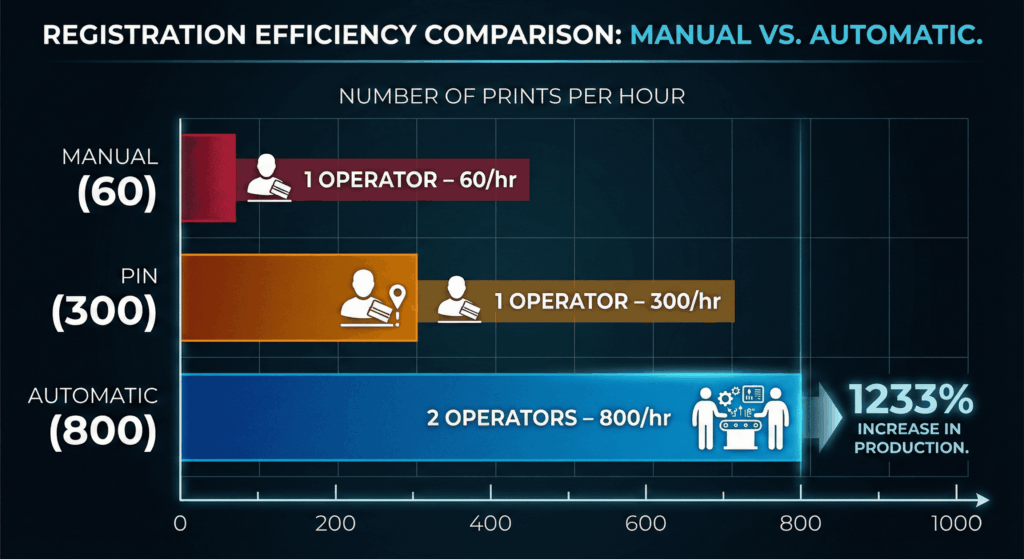
Manual registration systems offer lower initial investment costs suitable for smaller production runs. These systems typically cost around $200 for basic kits and produce 40-100 prints per hour. Manual systems are labor-intensive, requiring skilled operators to achieve consistent alignment through visual adjustment and pin-based positioning.
Automatic registration systems provide extremely high accuracy and repeatability with optical alignment capabilities. These systems range from a few thousand to over $100,000 and produce 500-800 prints per hour. Optical systems use cameras and servo motors to achieve registration accuracy of ±0.001 inches, significantly reducing labor requirements to only loading and unloading operations.
Labor requirements differ significantly between the two approaches. A 2025 production analysis shows automatic presses produce 500 prints per hour with two employees, while manual systems achieve 60 prints per hour with one employee. This 8-fold productivity increase makes automatic systems cost-effective for high-volume operations despite higher initial investment.
What Brands or Tools Are Commonly Used in Phoenix Shops?
Advanced Screen Print Supply operates locally in Phoenix, offering equipment and technical support to area screen printers. Their presence provides immediate access to parts, service, and consultation for registration system selection and maintenance.
M&R and Vastex brands show strong presence in the Phoenix market, suggesting local shops favor these established systems. M&R’s Tri-Loc pin registration and Vastex’s VRS systems are commonly specified for their reliability and precision. These brands offer both manual pin registration solutions and high-end automatic optical systems.
Catspit Screen Print Supply serves the Phoenix market with equipment options ranging from entry-level manual systems to professional automatic registration equipment. ScreenPrinting.com maintains a Phoenix location for supplies and equipment, providing local access to registration tools and technical expertise for system selection.
What Factors Drive the Choice of Registration Systems Among Phoenix Printers?
Production volume requirements determine system choice, with high-volume operations favoring automatic systems. The US custom screen printing market reached an estimated $9.2 billion in 2025, driving demand for efficient registration solutions that maximize throughput and minimize waste.
Budget constraints influence the decision between manual and automatic options. Entry-level manual systems start around $200, while professional automatic systems require investments of $10,000 to over $100,000. ROI analysis shows automatic presses offer better returns through higher production speeds despite higher initial costs.
Desired precision level impacts system selection significantly. High-end automatic systems achieve ±0.001-inch registration accuracy, essential for complex multi-color designs and tight tolerance work. Manual systems depend on operator skill but can achieve comparable accuracy with experienced technicians.
Phoenix’s environmental challenges also drive equipment choices. Local shops require systems that maintain accuracy despite temperature fluctuations, dust contamination from haboobs, and humidity variations during monsoon season. These factors favor robust automatic systems with enclosed operation and climate-controlled environments.
How Can Phoenix Businesses or Organizations Choose the Best Registration System for Their Needs?
Phoenix businesses succeed by matching registration systems to their specific production requirements and environmental conditions. The choice between manual and automatic systems depends on accuracy needs, volume targets, budget constraints, and operator skill levels. Local suppliers provide essential support and training to optimize system performance.
What Criteria Should Guide the Selection of a Registration System?
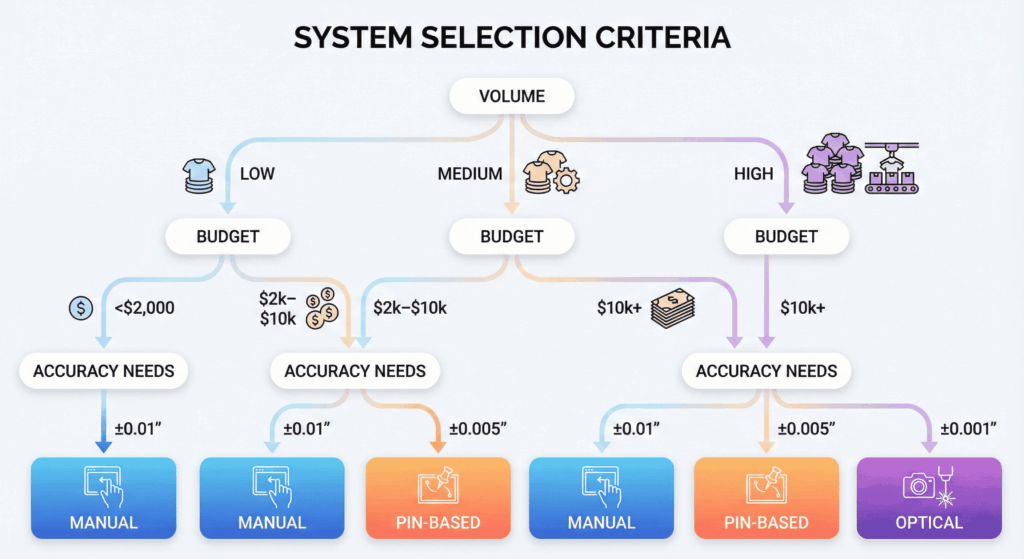
Registration accuracy requirements drive system selection, with high-end optical systems achieving ±0.001 inch precision compared to manual systems that depend on operator skill. Production speed needs determine the technology level—automatic systems produce 8-20x more prints per hour than manual alternatives, with volumes ranging from 40-100 prints/hour for manual to 500-800 prints/hour for automatic systems.
Available budget significantly impacts equipment choice, as registration systems range from a few hundred dollars for basic manual kits to over $100,000 for advanced automatic systems. Labor availability and operator skill levels also influence decisions, since manual systems require experienced technicians while automatic systems reduce dependency on operator precision through servo motors and camera-based alignment.
How Do Volume, Graphic Complexity, and Substrate Types Affect the Choice?
High-volume production benefits from automatic systems’ 500-800 prints/hour capacity, making them cost-effective despite higher initial investment. Complex multi-color designs require higher accuracy systems to maintain proper color registration across multiple ink layers, particularly in Phoenix’s challenging climate conditions.
Manual systems remain suitable for smaller production runs of 40-100 prints/hour, especially when budget constraints limit equipment options. The substrate type influences registration requirements—flexible materials need more precise systems to compensate for stretching, while rigid substrates allow greater tolerance with manual registration methods.
Where Can Phoenix Businesses Access Expert Advice or Demos?
Advanced Screen Print Supply provides technical support and equipment advice locally in Phoenix, offering hands-on consultation for system selection. ScreenPrinting.com’s Phoenix location delivers equipment consultation and demonstrations to help businesses evaluate different registration technologies.
Online training resources include courses from screenprinting.com and Vastex covering beginner to advanced registration techniques. Vastex offers a comprehensive 4-day Screen Printing A to Z Bundle training class that covers registration system operation and optimization strategies for Phoenix’s unique environmental conditions.
Phoenix businesses achieve optimal registration system performance by leveraging local expertise and understanding how volume requirements, graphic complexity, and environmental factors influence equipment selection decisions.
How Should You Approach Screen Printing Registration Systems in Phoenix with Thrive Screen Printing?
Screen printing registration systems in Phoenix require strategic consideration of local climate challenges, production volumes, and quality standards. Thrive Screen Printing offers comprehensive guidance on selecting and optimizing registration systems for Phoenix’s unique operating environment. This section covers partnership opportunities and essential takeaways for successful registration system implementation.
Can Thrive Screen Printing Help With Choosing and Maximizing Registration Systems in Phoenix?
Thrive Screen Printing provides comprehensive registration system consultation for Phoenix businesses seeking optimal print quality and production efficiency. The company’s Phoenix location offers screen printing, embroidery, and design services with emphasis on quality and customer service excellence. Their focus on high-quality custom apparel indicates use of professional-grade equipment capable of precise registration standards.
Thrive’s local expertise addresses Phoenix-specific challenges such as:
- Climate control requirements for monsoon humidity changes
- Dust mitigation strategies during haboob events
- Equipment selection for extreme temperature variations
- ROI optimization for different production volumes
The company’s commitment to quality suggests access to both manual and automatic registration systems, enabling tailored recommendations based on client production needs and accuracy requirements.
What Are the Key Takeaways About Screen Printing Registration Systems in Phoenix We Covered?
The key takeaways about screen printing registration systems in Phoenix encompass climate adaptation, investment strategy, and compliance requirements for successful operations.
Phoenix’s unique climate presents operational challenges requiring specialized approaches:
- Low humidity conditions affect screen tension and ink performance
- Monsoon season humidity spikes impact water-based ink drying
- Extreme summer heat accelerates ink curing and screen clogging
- Dust storms introduce PM10 particulates requiring enhanced filtration
Investment in appropriate registration systems directly impacts business metrics. Manual systems producing 40-100 prints/hour suit smaller operations with $200-$2,000 budgets, while automatic systems achieving 500-800 prints/hour justify higher initial costs through improved ROI in high-volume scenarios.
Local suppliers including Advanced Screen Print Supply and ScreenPrinting.com’s Phoenix location provide equipment access, technical support, and training resources. Compliance with OSHA Hazard Communication standards, EPA waste disposal regulations, and ISO 12647-5:2015 screen printing specifications ensures legal operation and quality consistency.
ROI analysis demonstrates automatic presses deliver superior returns for high-volume production despite higher upfront investment, making system selection a critical business decision for Phoenix screen printing operations.

Robert Fisher is the founder and CEO of Thrive Screen Printing and brings extensive experience in the screen printing and fulfillment industry.