


If you’re searching for custom apparel printing in Phoenix, whether for your business, event, or organization, you’ve come to the right place. We understand that navigating the world of custom printing can feel overwhelming with various methods, pricing options, and design considerations. Rest assured, we’ll guide you through everything you need to know about printing on t-shirts, hoodies, and caps in the Phoenix area, helping you make informed decisions for your custom apparel project.
Printing on apparel like t-shirts, hoodies, and caps in Phoenix is a thriving industry that combines technical expertise, creative design, and an understanding of the unique desert climate to deliver high-quality custom products for businesses, events, and individuals.
TL;DR Summary:
Here’s what we’ll cover about custom apparel printing in Phoenix:
• Why custom apparel is popular in Phoenix: Peak demand occurs October-April with the global market valued at $5.16 billion in 2024, driven by Phoenix’s vibrant business community and event calendar.
• Available printing methods: Screen printing offers economical bulk production, DTG enables photorealistic small runs with no minimums, and embroidery provides premium durability for caps and professional wear.
• Choosing the right apparel: 100% cotton works best for DTG printing while lightweight fabrics (4.5-5.3 oz) suit Phoenix’s extreme heat, with moisture-wicking options for athletic wear.
• Design options and customization: Unlimited colors with DTG, 1-10 colors for screen printing, specialty techniques like foil and metallic inks, plus trending desert themes and minimalist designs.
• The ordering process: Standard turnaround runs 7-14 days with rush options available, requiring design submission, proof approval, and quality inspection before delivery.
• Cost considerations: Screen printing costs $3-14 per unit depending on quantity, DTG runs $20.50-22.50 for small orders, with volume discounts up to 50% for 500+ pieces.
• Working with local printers: Phoenix providers offer faster turnaround, understand desert climate needs, use AI-powered quality control, and provide satisfaction guarantees.
• Thrive Screen Printing’s capabilities: Operating from a 40,000 sq ft facility, Thrive offers comprehensive printing methods, nationwide fulfillment, and specializes in advanced techniques like discharge and simulated process printing.
Quick Tip: Plan your custom apparel orders during Phoenix’s off-season (May-September) for faster turnaround times and potentially better pricing, as peak season demand from October-April can extend production times and increase rush order premiums by 25-50%.
Why Is Custom Apparel Printing Popular in Phoenix?
Custom apparel printing thrives in Phoenix due to the city’s unique seasonal patterns and robust business environment. Phoenix experiences peak demand from October through April when favorable weather drives outdoor events, corporate activities, and promotional campaigns. The global custom apparel market reached USD 5.16 billion in 2024 and projects growth at 11.5% CAGR through 2030, while the U.S. custom t-shirt market specifically grows from USD 2,407.67 million in 2023 to USD 4,261.65 million by 2032 at 6.55% CAGR. Phoenix’s vibrant business community, diverse event calendar, and expanding population create sustained demand across multiple sectors, though rush orders during peak season command premiums of 25-50% above standard pricing due to capacity constraints.
What Types of Businesses and Events Commonly Use Custom Printed Apparel?
The types of businesses using custom printed apparel include corporate branding programs, sports organizations, educational institutions, non-profits, entertainment venues, and local businesses. Corporate branding programs drive increasing demand for employee apparel initiatives. Sports teams regularly order custom uniforms and fan merchandise. Educational institutions require apparel for students, staff, and promotional events. Non-profit organizations utilize custom apparel for fundraising and awareness campaigns. Entertainment venues and music festivals generate substantial orders for event merchandise. Local businesses leverage custom apparel for marketing and brand visibility.
How Do Climate and Local Trends Influence Apparel Choices in Phoenix?
Climate and local trends significantly influence apparel choices through Phoenix’s extreme conditions and cultural preferences. Phoenix experiences summer heat of 110-120°F+ with 10-30% humidity, requiring lightweight cotton at 4.5-5.3 oz versus standard 5.3-6.0 oz weights. The city’s intense UV exposure ranks among the highest in continental U.S., demanding special consideration for print durability. Desert-themed graphic tees featuring cactus motifs, mountain silhouettes, and warm sunset hues dominate local fashion. Peak season from October-April creates predictable revenue patterns for capacity planning. Discharge printing produces superior softness and breathability ideal for Phoenix’s warm climate by creating prints that feel like part of the fabric itself.
This seasonal demand cycle and climate considerations position Phoenix as a unique market where printing companies must balance weather-appropriate materials with the city’s distinctive aesthetic preferences and business patterns.
What Printing Methods Are Available for T-Shirts, Hoodies, and Caps?
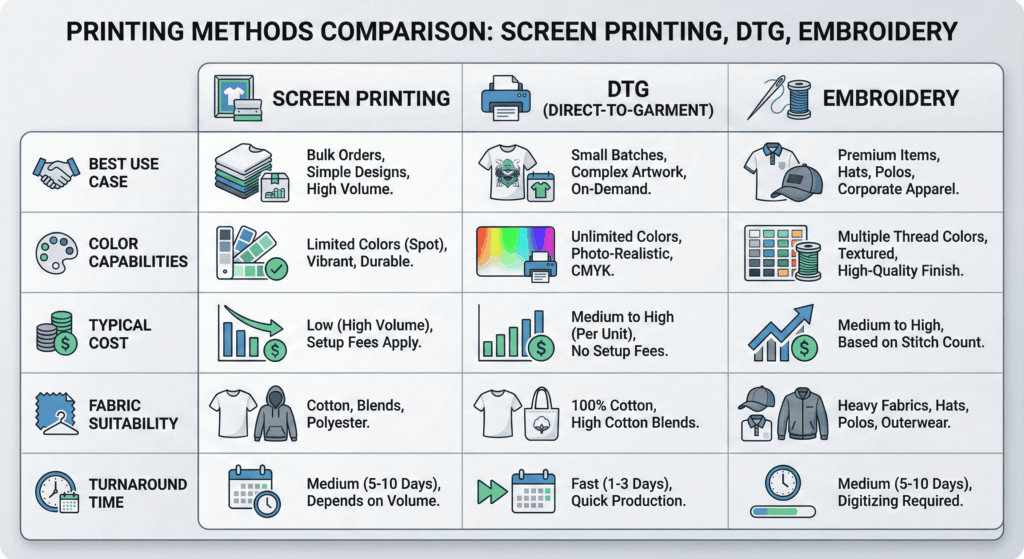
Printing methods for T-shirts, hoodies, and caps include screen printing, Direct-to-Garment (DTG), and embroidery, each serving distinct needs and order volumes. Screen printing applies ink through stencils and excels for bulk orders, while DTG uses inkjet technology for photorealistic designs without setup requirements. Embroidery creates premium stitched finishes ideal for caps and professional apparel. According to industry data from 2024, the global DTG market is valued at USD 1.92 billion and projected to reach USD 3.90 billion by 2030 with a 13.0% CAGR. These methods will be explored in detail to help you select the optimal approach for your specific project requirements and budget.
What Is Screen Printing and When Is It the Best Choice?
Screen printing is the most economical method for larger quantities of 500+ units where setup costs of $20-50 per screen are distributed effectively across the production run. This method proves ideal for bulk orders through fast production speeds once setup completes, with properly cured plastisol inks maintaining quality after 50-100+ wash cycles. Thrive Screen Printing offers advanced techniques such as simulated process printing using 7-10 ink colors to create photorealistic images, with setup fees ranging $280-600 for typical 8-screen jobs. Water-based inks provide superior softness, biodegradability, and reduced VOC emissions compared to traditional plastisol options. Orders exceeding 500 pieces reduce per-unit costs by 30-50% compared to smaller runs, making screen printing the preferred choice for large-scale promotional campaigns and corporate apparel programs.
How Does Embroidery Compare to Other Printing Methods?
Embroidery creates extremely durable stitching that remains permanent without fading or cracking, offering superior longevity compared to printed methods. Design digitizing costs range from $0.99-$10+ per design in the Phoenix market, with per-piece costs spanning $3-15 depending on complexity and garment type. This method limits designs to typically 5-10 thread colors maximum, contrasting with DTG’s unlimited color capability. Standard turnaround time extends 10-14 business days, longer than screen printing or DTG alternatives. Minimum orders typically require 6 pieces, though some Phoenix providers offer no minimums on hats and polos. Embroidery creates a premium, high-end appearance particularly valued for corporate uniforms and professional apparel where durability and perceived quality matter most.
What Are the Advantages and Limitations of Direct-to-Garment (DTG) Printing?
DTG allows exceptional clarity and detail for complex designs with gradients and unlimited colors without minimum order requirements, enabling single-item on-demand printing. Per-piece pricing starts at $20.50 for white garments and $22.50 for dark garments in 1-11 piece orders, with bulk discounts available for larger quantities. This method performs best on 100% cotton and cotton blends with at least 80% cotton content, while dark garments require pre-treatment processes to ensure proper ink adhesion. According to 2024 market data, the DTG clothing segment is worth USD 985.7 million and expected to more than double by 2030. DTG offers slower per-unit production than screen printing but faster setup without screen requirements, making it ideal for small batches, prototypes, and personalized items with complex artwork.
How Do You Choose the Right Apparel for Custom Printing?
Choosing the right apparel for custom printing requires matching fabric compatibility with your chosen printing method and Phoenix’s unique climate demands. Fabric compatibility varies significantly by printing method—DTG requires high cotton content while screen printing works on various materials. Phoenix’s extreme UV exposure requires consideration of tightly woven fabrics that provide better UV protection than open weaves.
Cotton and cotton blends offer breathability, durability, and quick drying in Phoenix’s dry climate. Moisture-wicking synthetics provide excellent moisture management but can trap heat in extreme temperatures. Tri-blend and premium fabrics offer superior softness but come at higher base costs affecting project pricing.
The following sections detail specific apparel requirements, fabric performance characteristics, and style matching strategies for successful custom printing projects in Phoenix’s demanding environment.
What Should You Look For in T-Shirts, Hoodies, and Caps for Printing?
T-shirts require specific weight and material considerations for Phoenix conditions. The optimal choice is 100% cotton at 5.3-6.0 oz weight, though lighter weights (4.5-5.3 oz) are preferred for Phoenix heat. Hoodies perform best with 80% cotton/20% polyester blend at 7.5-8.0 oz weight, providing durability with peak demand occurring October-April.
Caps should use 100% cotton twill in structured or unstructured styles, with embroidery as the preferred customization method. Consider UV protection as an important factor for outdoor event caps in the Phoenix market. Recycled polyester naturally contains UV-resistant properties meaning prints won’t fade as quickly under Arizona’s intense sun exposure.
Key Garment Specifications:
- T-shirts: 100% cotton, 4.5-5.3 oz weight for heat tolerance
- Hoodies: 80/20 cotton/polyester blend, 7.5-8.0 oz weight
- Caps: 100% cotton twill with UV protection features
- Seasonal timing: Peak hoodie demand October-April only
How Do Fabric Types Affect Print Quality and Durability?
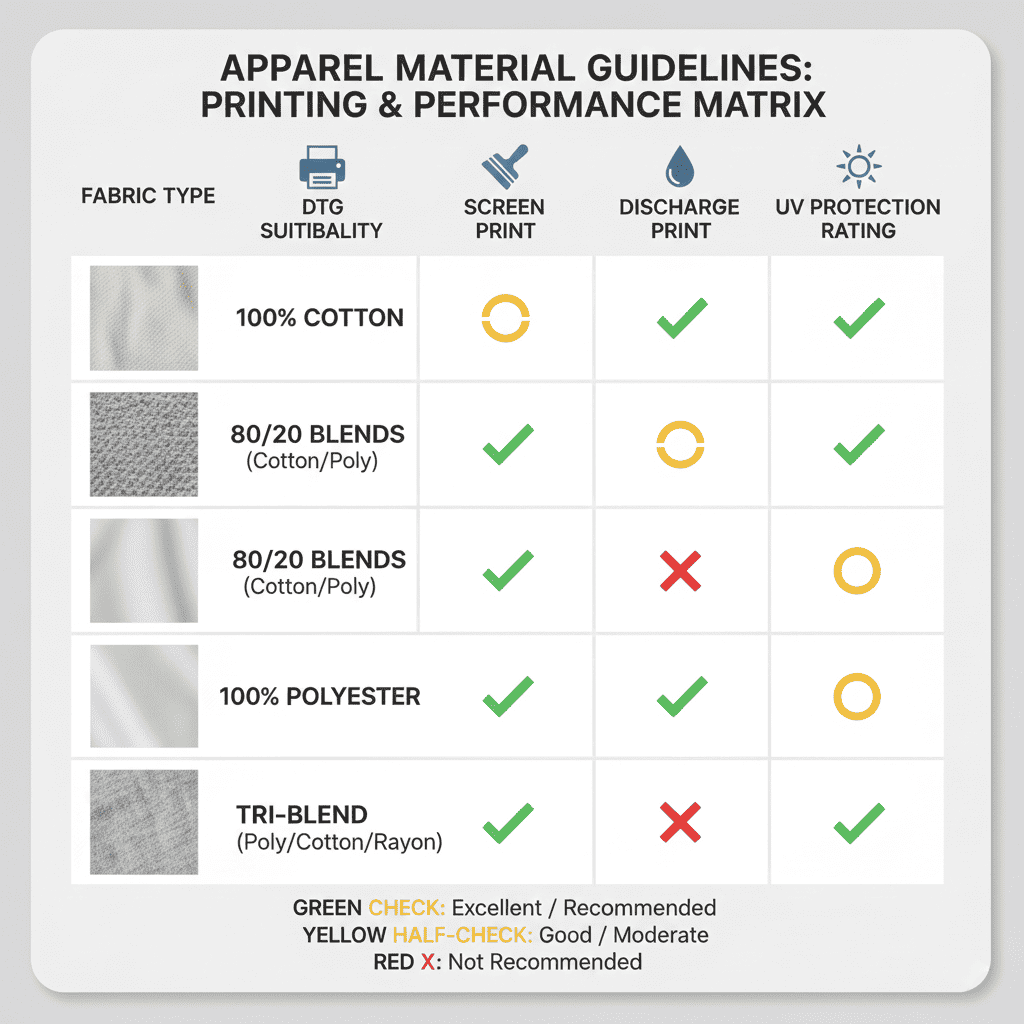
Fabric types determine print quality and longevity across different printing methods. 100% cotton provides the highest absorbency and most vibrant prints for DTG printing. Cotton/polyester blends (90/10 or 80/20) offer balance of comfort and durability for multiple printing applications.
100% polyester shows poor ink absorption for DTG—avoid this combination entirely. Tightly woven fabrics like denim and flannel provide superior UV protection compared to open weaves. Discharge printing requires 100% natural fibers (cotton, bamboo, hemp) for proper chemical activation.
| Fabric Type | DTG Performance | Screen Print | Discharge Compatible | UV Protection |
| 100% Cotton | Excellent absorption | Good | Yes | Moderate |
| Cotton/Poly 80/20 | Good performance | Excellent | Partial | Good |
| 100% Polyester | Poor absorption | Good | No | Excellent |
| Tri-blend | Moderate | Good | Partial | Good |
Water-based inks perform best on natural fibers while plastisol works across various fabric types, providing flexibility for different project requirements.
How Can You Match Apparel Styles to Your Brand or Event?
Apparel styles should reflect Phoenix’s unique aesthetic and cultural preferences. Desert-themed designs with cactus imagery and sunset palettes appeal to both residents and tourists. Arizona shirts for women blend bohemian charm with Western influences using embroidery details and fringe accents.
Color preferences include neutrals (beige, cream, tan) with accent colors like turquoise (iconic Arizona color), coral, and terracotta. Western hats serve as bold style statements with customization options including turquoise stones and braided leather. Lightweight crewnecks and sweaters in oversized fits with vintage-inspired prints trend during October-April layering season.
Phoenix Design Elements:
- Desert motifs: cactus, mountain silhouettes, sunset gradients
- Color palette: neutrals with turquoise, coral, terracotta accents
- Western influences: embroidery, fringe, braided leather details
- Seasonal styles: lightweight layers for October-April peak season
These styling choices connect your custom apparel to local culture while ensuring comfort in Phoenix’s challenging climate conditions.
What Design Options and Customization Features Can You Use?
Design options for custom apparel printing in Phoenix range from photorealistic imagery to specialty effects that enhance brand visibility. DTG printing delivers photorealistic designs with unlimited colors, while simulated process screen printing achieves similar results using 7-10 strategically combined colors. Specialty techniques include glitter inks, metallic finishes, foil printing, high-density textures, and glow-in-the-dark effects that create memorable promotional pieces.
Current embroidery trends favor minimalist line art, dimensional 3D puff lettering, and retro patch-style designs that appeal to Phoenix’s diverse market. Personalization options expand beyond basic text to include individual names, custom photography integration, monograms, and limited edition designs for special events. AI-powered design tools now assist with graphic creation and full design automation, dramatically accelerating product launch cycles from concept to production.
This section explores best practices for artwork preparation, color and placement limitations, and minimum order requirements across different printing methods.
What Are the Best Practices for Designing Art for Apparel Printing?
The best practices for designing apparel artwork depend on your chosen printing method and require specific technical considerations. Vector graphics provide optimal quality for screen printing with infinite scalability, while DTG printing requires a minimum 300 DPI resolution to ensure sharp detail reproduction. Dark garments often need white underbase layers for vibrant color reproduction, particularly important in Phoenix’s intense UV environment.
Simulated process printing combines spot colors with halftones and gradients to simulate thousands of apparent colors from a limited palette of 7-10 screens. Embroidery designs require simplification since complex details may not translate effectively to thread work. Account for print location limitations based on your chosen method and equipment capabilities – chest pockets, seams, and hardware can restrict placement options.
Key artwork preparation guidelines include:
- Submit vector files (.AI, .EPS) for screen printing scalability
- Provide high-resolution raster files (300+ DPI) for DTG applications
- Consider fabric color interaction when selecting ink colors
- Simplify line weights and details for embroidery applications
- Plan print placement around garment construction features
How Many Colors and Print Locations Are Possible?
Color capabilities and print locations vary significantly by printing method, affecting both design possibilities and project costs. Screen printing typically handles 1-6 spot colors efficiently, with a simulated process extending capabilities to 7-10 colors for photorealistic effects. DTG printing offers unlimited colors with no additional cost per color, making it ideal for complex photography or gradient-heavy designs.
Embroidery remains limited to 5-10 thread colors for practical and cost considerations, though creative thread combinations can suggest additional hues. Standard print locations include front chest, full front, back, sleeves, and specialty placements like pocket areas or sleeve cuffs. Multiple print locations may require additional setup fees for screen printing, while DTG and embroidery typically charge per location.
| Printing Method | Color Limit | Common Locations | Setup Considerations |
| Screen Printing | 1-6 spot, 7-10 simulated | Front, back, sleeves | $20-50 per screen |
| DTG | Unlimited | Front, back, sleeves | No color restrictions |
| Embroidery | 5-10 threads | Front chest, back, sleeves | Digitizing required |
Caps typically accommodate front panel, side, and back embroidery positions, with curved surfaces requiring specialized equipment and techniques.
Can You Print Small Quantities or Do You Need to Order in Bulk?
Order quantity requirements depend entirely on your chosen printing method, with DTG offering the most flexibility for small runs. DTG printing has no minimum order requirements, allowing single-item on-demand production perfect for testing designs or personal use. Screen printing typically requires 50-100 piece minimums due to setup costs, though some Phoenix providers offer 6-piece minimums for certain items.
Embroidery minimums typically start at 6 pieces, though providers like Same Day Custom in Phoenix offer no minimums on hats and polos. Volume discounts begin at 50-100 pieces for screen printing, with substantial savings of 30-50% achievable at 500+ piece quantities. These volume breaks make screen printing increasingly economical for larger orders despite higher initial setup costs.
Same Day Custom in Phoenix demonstrates market innovation by offering 1-hour local printing with no minimum orders, though premium pricing applies for such rapid turnaround. This flexibility serves Phoenix’s dynamic event market and last-minute promotional needs effectively.
What Is the Process for Ordering Custom Printed Apparel in Phoenix?
The process for ordering custom printed apparel in Phoenix involves consultation, quoting, art preparation, production scheduling, and quality control. Initial consultation includes design review, quantity confirmation, and printing method selection to determine the best approach for your project. Quote generation typically includes setup fees ranging $20-50 per screen, per-unit costs varying by method and quantity, and any additional services like rush processing or specialty inks.
Art preparation requirements differ by method—digitizing for embroidery costs $0.99-$10+ per design while screen creation ranges $20-50 per screen for screen printing projects. Production scheduling depends on the method chosen and current capacity utilization, with AI-powered sensors and real-time analytics increasingly common for detecting errors mid-production. This systematic approach ensures projects move efficiently from concept to completion while maintaining quality standards.
The following sections detail each phase from quoting through delivery, typical production timelines, and local regulatory requirements that may apply to your custom apparel order.
What Steps Are Involved from Quoting to Delivery?
The steps from quoting to delivery follow a structured workflow ensuring quality and timely completion. Design submission requires appropriate format—vector files for screen printing or high-resolution images for DTG printing. Proof approval is required before production begins, allowing clients to review colors, placement, and overall appearance.
Pre-production samples may be created for large orders or new designs to verify quality before full production runs. Production runs according to the scheduled timeline based on method and quantity. Final quality inspection occurs before packaging to catch any defects or inconsistencies. Shipping or local pickup arrangements are completed based on client preferences and delivery requirements.
How Long Does Production and Shipping Usually Take?
Production and shipping timelines vary by printing method and season in Phoenix. Standard turnaround includes screen printing at 7-10 business days, DTG at 7-10 days, and embroidery at 10-14 days for typical orders. Same-day options are available in Phoenix with 1-hour turnaround for rush orders at premium pricing.
Rush options add cost premiums—24-48 hour rush adds 15-25% premium while 48-72 hour rush adds 10-15% premium. Peak season from October-April may extend standard turnaround to 10-14 days due to capacity constraints from increased demand. Off-season from May-September may offer a faster turnaround of 5-7 days when production capacity is more available. Nationwide shipping is available from major providers like Thrive Screen Printing for clients outside the Phoenix area.
Are There Local Regulations or Requirements for Branded Apparel?
Local regulations and requirements affect custom apparel businesses operating in Phoenix and Arizona. Arizona does not issue or require a state business license, but most municipalities require local licenses for business operations. Transaction Privilege Tax (TPT) license is required for businesses selling products subject to Arizona sales tax, with remote sellers paying $12 for a TPT license valid for one year and renewable at no cost.
Maricopa County Air Pollution Control Regulations apply to printing operations involving volatile organic compounds (VOCs) from various printing processes. Discharge printing requires proper ventilation and compliance verification for chemical emissions due to environmental safety requirements. EPA TSCA regulations impact all chemicals including printing inks with Significant New Use Rules (SNURs) and Significant New Use Notices (SNUNs) requirements that printing facilities must follow.
How Much Does It Cost to Print T-Shirts, Hoodies, and Caps in Phoenix?
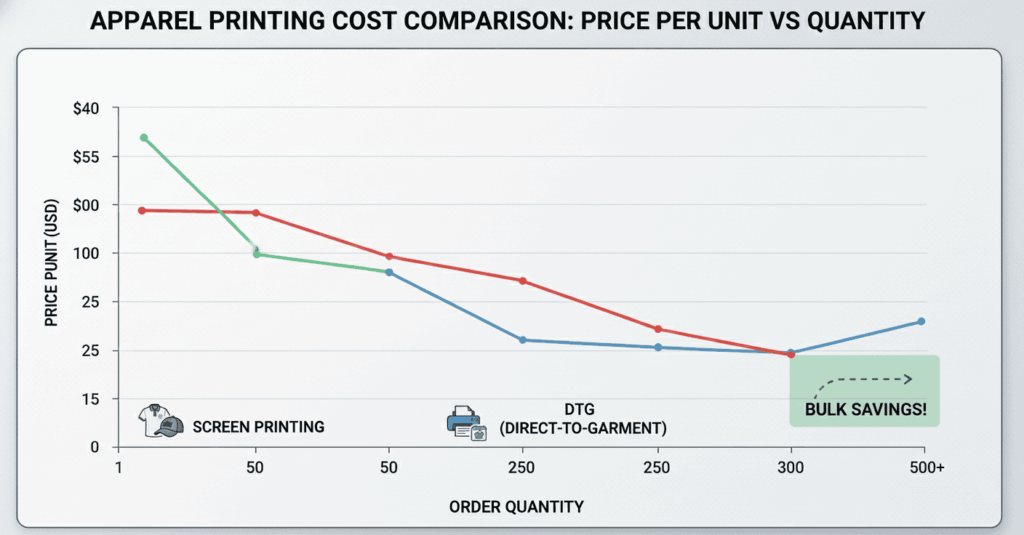
Custom apparel printing costs in Phoenix vary significantly based on printing method, order quantity, and design complexity. Screen printing setup fees range $20-50 per screen with per-unit costs of $3-14 depending on colors and quantity. DTG printing costs $20.50 per white garment or $22.50 per dark garment for small orders with bulk discounts available. Embroidery digitizing costs $0.99-$10+ with per-piece costs of $3-15 depending on complexity.
Volume discounts create substantial savings opportunities—orders of 250-500 pieces save 15-25%, while 500+ pieces save 30-50%. Peak season (October-April) rush premiums may increase costs by 25-50% due to capacity constraints. The following sections detail cost factors and money-saving strategies.
What Factors Influence the Total Cost of Custom Apparel Printing?
Order quantity has the largest impact on pricing, as higher volumes significantly reduce per-unit costs through economies of scale. The number of colors affects screen printing costs since each color requires a separate screen at $20-50 per setup. Garment quality and type influence base costs—premium fabrics and specialty items cost more than standard options.
Design complexity impacts setup time and production difficulty, with intricate artwork requiring additional preparation. Rush orders command premiums of 15-50% depending on turnaround time requirements. Multiple print locations may require additional setups, increasing total project costs. Specialty inks such as metallic, foil, or glow-in-dark options add 10-15% to base pricing.
How Can You Save Money Without Sacrificing Quality?
Ordering in bulk maximizes volume discounts, with 500+ pieces reducing costs by 30-50% compared to smaller quantities. Simplifying designs reduces color count for screen printing, eliminating unnecessary screen setup fees. Choosing standard ink colors avoids specialty ink premiums while maintaining professional appearance.
Planning ahead prevents rush order fees of 15-50% by allowing normal production schedules. Consider DTG for small orders to avoid screen setup fees entirely. Using your provider’s blank inventory eliminates markup on garments. Repeat orders of identical designs may qualify for reduced setup fees, creating long-term savings opportunities for ongoing projects.
The cost structure for custom apparel printing in Phoenix reflects both method-specific requirements and local market dynamics, making strategic planning essential for budget optimization.
What Should You Expect When Working with a Local Printer in Phoenix?
Working with a local printer in Phoenix provides faster turnaround times, easier communication, and opportunities for in-person consultations. Local providers understand Phoenix’s unique market preferences, including desert themes and seasonal demand patterns that peak from October through April. Quality control processes increasingly use AI-powered sensors for real-time error detection, while many providers offer satisfaction guarantees with free reprints for defective items.
Phoenix-based printing companies understand the local climate’s impact on apparel choices and offer specialized services like same-day rush orders. Local presence enables easier resolution of issues and last-minute changes while supporting the local economy through reduced shipping distances. This section explores how local printers ensure quality and the specific benefits of choosing Phoenix-based apparel printing companies.
How Do Local Printers Ensure Quality and Customer Satisfaction?
AI-powered quality control systems detect print errors and color mismatches mid-production, dramatically improving output quality. Automated workflows reduce manual processes and human error, while digital pre-press technology ensures color accuracy and consistency across large orders.
Many providers offer satisfaction guarantees with free reprints for defects, protecting your investment. Established providers like Designed In Ink, operating since 2010, maintain their reputation through consistent quality delivery. Real-time monitoring and analytics improve production consistency by tracking variables such as:
- Ink viscosity and temperature
- Print registration accuracy
- Color matching to approved samples
- Cure time and temperature monitoring
What Are the Benefits of Choosing a Phoenix-Based Apparel Printing Company?
Phoenix-based companies understand local climate considerations, recommending lightweight fabrics and UV-resistant inks for the desert environment. Their knowledge of seasonal demand patterns enables better capacity planning and faster service during peak periods from October through April.
Same-day and rush services are available for urgent local needs, with some providers offering 1-hour turnaround times. Support for the local economy reduces shipping distances and environmental impact while providing easier coordination for large events and ongoing partnerships. Local companies maintain familiarity with Arizona design preferences including desert themes, turquoise accents, and cultural elements that resonate with both residents and tourists.
Compliance with Maricopa County Air Pollution Control Regulations is already established, ensuring proper handling of discharge printing chemicals and VOC emissions without additional delays for permit verification.
How Can Thrive Screen Printing Help With Your Custom Apparel Needs in Phoenix?
Thrive Screen Printing operates from a 40,000 square-foot state-of-the-art facility in Phoenix, serving clients nationwide with comprehensive custom apparel solutions. The company holds recognition as America’s 1 custom screen printing services company, delivering projects for businesses ranging from small startups to large-scale global enterprises, including Grammy-related events.
Thrive’s Phoenix location provides strategic advantages for local businesses through faster turnaround times and deep understanding of Arizona’s unique climate requirements. The facility offers fast worldwide fulfillment with a commitment to on-time delivery, supported by advanced production capabilities and quality control systems. For consultation and quotes, contact (602) 607-2171 or email info@thrivescreenprinting.com.
The upcoming section details Thrive’s comprehensive service offerings and specific expertise in custom apparel production methods.
What Services Does Thrive Screen Printing Offer for T-Shirts, Hoodies, and Caps?
Thrive Screen Printing offers comprehensive printing methods including screen printing, DTG, simulated process, discharge, water-based, plastisol, foil, flock, gel, high-density, and metallic ink printing. The company specializes in contract screen printing for large-scale orders with wholesale pricing structures that benefit high-volume clients.
Core Services and Specializations:
- Custom band merchandise and event merchandise production
- Apparel fulfillment services including finishing and custom clothing tags
- Green printing with eco-friendly options using water-based inks
- Specialized discharge printing at $3.50-$2.20 per unit meeting Maricopa County Air Pollution regulations
- Simulated process expertise using 7-10 colors for photorealistic images
Thrive’s simulated process capability creates photorealistic designs by combining multiple ink colors to achieve complex visual effects typically requiring dozens of apparent colors. Their discharge printing services comply with Maricopa County environmental regulations while delivering superior softness ideal for Phoenix’s warm climate.
What Are the Key Takeaways About Printing on Apparel: T-Shirts, Hoodies & Caps in Phoenix We Covered?
The global custom apparel market is expected to reach USD 145.9 billion by 2033, growing at 9.6% CAGR, with Phoenix positioned to capitalize on this growth through seasonal demand cycles and business expansion. The Phoenix market benefits from unique climate considerations that drive specific fabric and printing method preferences.
Market and Technical Insights:
- Multiple printing methods serve different needs: screen printing for bulk orders, DTG for small runs, embroidery for premium applications
- Fabric selection proves crucial for Phoenix climate—lightweight cotton and moisture-wicking materials perform best in extreme heat
- Pricing varies significantly by quantity, method, and complexity with volume discounts reaching up to 50%
- Technology integration including AI quality control and automated workflows is transforming production efficiency
Industry Trends and Local Advantages:
- Sustainability trends drive adoption of water-based inks and discharge printing methods
- Local providers offer advantages in turnaround time, market knowledge, and regulatory compliance
- Peak season demand (October-April) creates predictable revenue patterns for capacity planning
Phoenix’s custom apparel market combines growing demand with specialized requirements that favor experienced local providers who understand climate considerations, seasonal patterns, and regulatory compliance requirements.

Robert Fisher is the founder and CEO of Thrive Screen Printing and brings extensive experience in the screen printing and fulfillment industry.