


If you’re exploring modern printing methods for your custom apparel business or personal projects, you’re likely weighing the pros and cons of DTG (Direct-to-Garment) versus DTF (Direct-to-Film) printing. We understand the importance of choosing the right technology that aligns with your production needs, budget, and quality expectations. You’re in the right place—this comprehensive guide will help you make an informed decision between these two revolutionary printing methods.
Direct-to-Garment (DTG) and Direct-to-Film (DTF) printing are digital textile printing technologies that have transformed the custom apparel industry by enabling high-quality, on-demand production without the setup costs and minimum quantities required by traditional screen printing.
TL;DR Summary:
• DTG and DTF printing technologies each offer distinct workflows: DTG prints directly onto garments using specialized inkjet technology, while DTF prints designs onto special film that transfers to fabrics via heat press.
• Equipment requirements vary significantly between methods, with DTG systems costing $20,000-$250,000+ compared to DTF’s more accessible $5,000-$15,000+ range, though both require specific consumables and maintenance protocols.
• DTG excels for high-quality prints on natural fibers with soft hand feel, making it ideal for premium custom orders and intricate designs on cotton garments.
• DTF provides superior versatility across fabric types including polyester, nylon, and leather, with excellent durability and lower per-print costs for larger production runs.
• Print quality and durability differ notably: DTG offers exceptional detail with a soft feel but may fade over time, while DTF delivers vibrant, highly durable prints with a slightly textured finish.
• Cost analysis reveals DTG’s higher per-print expenses ($2-$5/shirt) versus DTF’s economical pricing ($0.10-$0.50/print), though startup costs favor DTF for entry-level businesses.
• Environmental considerations include water-based inks for both methods, with DTG requiring chemical pre-treatments and DTF involving plastic films that the industry is working to make more sustainable.
• Choosing between methods depends on your specific needs: order size, garment types, production volume, and whether you prioritize print feel or substrate versatility.
• Professional services like Thrive Screen Printing offer both technologies alongside traditional screen printing, providing expert guidance for businesses navigating these printing options.
Quick Tip: If you’re just starting out and need maximum flexibility with fabric types, DTF printing offers the lowest barrier to entry and broadest material compatibility—perfect for testing diverse product offerings without major upfront investment.
How Do DTG and DTF Printing Technologies Work?
DTG and DTF printing technologies operate through distinct processes that determine their applications and outcomes. DTG prints designs directly onto garments using specialized inkjet technology, while DTF creates transfers on film before applying them to textiles. Understanding these fundamental differences helps businesses select the optimal printing method for their specific requirements.
What Is the Process of Direct-to-Garment (DTG) Printing?
Direct-to-garment printing involves three main stages: pre-treatment of the garment, printing the design, and curing the ink with heat. The process begins by securing the garment on a platen before applying a pre-treatment solution, especially for dark garments. DTG uses specialized inkjet technology to print designs directly onto textiles and garments with precision. The final step involves curing the ink using a heat press or conveyor dryer to ensure washability and durability.
This method transforms digital artwork into physical prints through water-based ink application. The pre-treatment solution creates a receptive surface for optimal ink adhesion and color vibrancy. Heat curing polymerizes the ink molecules, creating permanent bonds with fabric fibers that withstand repeated washing cycles.
What Is the Process of Direct-to-Film (DTF) Printing?
Direct-to-film printing involves printing designs onto special PET film, then transferring to garments using a heat press. The process includes applying hot-melt adhesive powder to wet ink on the film immediately after printing. The powder is cured to create an adhesive layer before heat-pressing the film onto the garment. DTF allows printing on a wider variety of materials compared to DTG, including synthetic fabrics and non-textile surfaces.
The transfer film acts as an intermediary carrier that enables versatile substrate compatibility. Hot-melt adhesive powder creates the bonding mechanism between printed design and final garment. This two-step process separates design creation from application, allowing for inventory management of pre-printed transfers.
What Equipment Is Required for Each Printing Method?
The equipment requirements reveal significant cost differences between DTG and DTF technologies:
| Equipment Type | DTG Cost Range | DTF Cost Range | Key Features |
| Initial Setup | $20,000-$250,000+ | $5,000-$15,000+ | Entry barrier difference |
| Ricoh Ri 4000 | High-end DTG | Hybrid capability | 16″ x 19.6″ print area, automatic pretreatment |
| Brother GTXpro | Production DTG | High volume | 57 light garments per hour |
| Epson SureColor G6070 | – | DTF specialist | 35.4″ width, 1,200 x 600 dpi |
| xTool Apparel | – | Entry DTF | Dual I1600 heads, 14″ width, 720 x 1800 dpi |
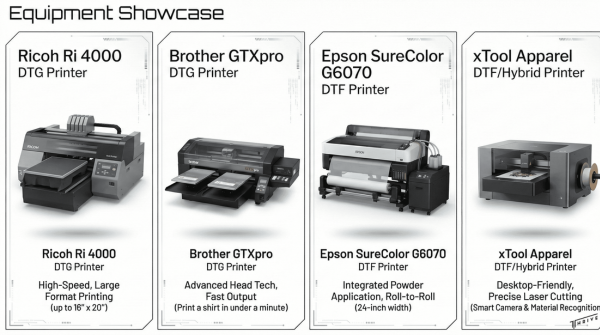
DTG equipment requires significant capital investment but offers direct printing capabilities. DTF systems provide lower entry costs with comparable print quality across diverse substrates. Production capacity varies significantly between models, with high-end DTG systems achieving rapid throughput for specific garment types.
How Do Ink Types Differ Between DTG and DTF Printing?
DTG ink costs approximately $2-$5 per shirt compared to DTF ink costs of $0.10-$0.50 per print. Both technologies utilize water-based inks, which are generally more eco-friendly than plastisol inks used in traditional screen printing. DTF inks are now OEKO-TEX certified to ensure they are free from harmful substances. DTG requires pre-treatment solution as a consumable, while DTF requires transfer film and adhesive powder as consumables.
Water-based ink formulations provide environmental advantages through reduced volatile organic compounds and easier cleanup. The cost difference reflects ink consumption patterns, with DTG depositing ink directly into fabric fibers and DTF using precise film application. These consumable requirements affect operational planning and inventory management for printing businesses.
This section establishes the technical foundation for understanding how DTG excels in premium quality applications while DTF offers cost-effective versatility for diverse printing scenarios.
What Are the Advantages of DTG Printing Compared to DTF?
DTG printing offers superior quality for custom apparel businesses focused on premium, on-demand production. DTG excels in producing high-quality prints with exceptional soft hand feel, making it ideal for intricate designs on natural fibers. The technology allows businesses to charge premium prices for single, custom prints without minimum order requirements, creating profitable opportunities in the custom apparel market.
When Should You Choose DTG Printing?
DTG printing is optimal for businesses prioritizing quality over quantity in their production model. The technology excels in high-quality, on-demand printing on natural fibers, particularly 100% cotton garments where vibrancy reaches its peak. A Big Frog franchise successfully demonstrates DTG’s effectiveness by producing under 1,500 prints per month, turning most orders around in 24 hours while maintaining premium quality standards.
Key advantages include:
- Premium pricing capability for single, custom prints with no minimum order quantity
- High-quality output with soft hand feel ideal for intricate, detailed designs
- Fast turnaround times for small batches and personalized orders
- Superior color reproduction on cotton and cotton-blend substrates
DTG’s on-demand capability transforms customer expectations, allowing businesses to offer same-day or next-day delivery for custom designs. This positions DTG as the preferred choice for retail locations, custom gift shops, and businesses serving customers who value quality over cost savings.
What Are the Limitations of DTG Printing?
DTG printing presents operational challenges that impact daily workflow and production capacity. The technology requires regular, often daily, maintenance to prevent clogging of print heads, making consistent upkeep essential for reliable operation. DTG operates slower for production compared to DTF, making it ideal for small runs and on-demand orders rather than bulk manufacturing.
Primary limitations include:
- Substrate restrictions to cotton and cotton blends, limiting material versatility
- Higher ink consumption costs of approximately $2-$5 per shirt versus DTF’s $0.10-$0.50 per print
- Print longevity concerns as DTG prints may fade over time with repeated washing
- Pre-treatment requirements that add processing time and chemical handling
According to industry testing, DTG prints show good initial durability but may experience gradual fading compared to other printing methods when subjected to frequent washing cycles. These limitations make DTG less suitable for high-volume production environments or businesses requiring diverse substrate options.
DTG’s advantages in quality and customization capabilities must be weighed against its operational demands and cost structure. The next section explores how DTF printing addresses many of these limitations while presenting its own trade-offs.
What Are the Advantages of DTF Printing Compared to DTG?
DTF printing offers superior versatility, cost efficiency, and production scalability compared to DTG printing. DTF works on diverse substrates like cotton, polyester, nylon, and leather, while providing faster production for larger orders through pre-printed transfers.
According to a 2024 market analysis, the DTF printing market was valued at USD 2.72 billion and projected to reach USD 3.92 billion by 2030, demonstrating rapid adoption. DTF enables pre-printing transfers during downtime, then heat-pressing multiple garments quickly during production rushes. This approach reduces bottlenecks and improves workflow efficiency for custom apparel businesses.
When Should You Choose DTF Printing?
DTF printing excels when businesses need substrate versatility, cost control, and scalable production. DTF transfers work on cotton, polyester, nylon, leather, and various fabric blends, offering flexibility that DTG cannot match. Pre-printed transfers enable faster batch processing, making DTF ideal for orders exceeding 50 pieces.
Cost advantages become pronounced with volume. DTF ink costs range from $0.10-$0.50 per print compared to DTG’s $2-$5 per shirt, creating significant savings on larger orders. Equipment investment starts lower too, with DTF systems ranging from $5,000-$15,000 versus DTG’s $20,000-$250,000+ initial costs.
Optimal DTF scenarios include:
- Mixed-fabric orders requiring consistent quality
- Seasonal production with advance transfer preparation
- Contract printing serving multiple substrate types
- International shipping where pre-made transfers reduce customs complexity
What Are the Limitations of DTF Printing?
DTF printing produces a slightly textured feel compared to DTG’s soft hand sensation. The transfer creates a thin film layer on fabric surfaces, which some customers notice during wear. This texture difference affects premium garment applications where hand feel matters most.
Environmental concerns center on PET films and hot-melt powders contributing to plastic waste. A 2023 sustainability study found DTF processes generate more non-biodegradable waste than water-based DTG printing. Industry manufacturers are developing recyclable films and eco-friendly powders to address these concerns.
The heat press transfer step adds production complexity and potential failure points. Operators must manage temperature, pressure, and timing variables for each substrate type. Incorrect settings cause poor adhesion or fabric damage, requiring reprints and waste.
This section connects to broader quality and durability comparisons, where both methods show distinct performance characteristics across different fabric types and wash conditions.
How Do Print Quality and Durability Compare Between DTG and DTF?
Print quality and durability represent critical factors when choosing between DTG and DTF printing methods. DTG excels in producing soft-hand designs on natural fibers, while DTF offers superior durability across diverse materials. Understanding these differences helps businesses select the optimal printing method for their specific requirements.
How Do Colors and Details Differ in Each Method?
DTG produces vibrant colors with exceptional detail reproduction, particularly excelling in soft-hand feel applications. The Kornit Breeze DTG printer delivers up to 1,200 dpi resolution through 6 specialized print heads, ensuring crisp text and intricate design elements. High-end DTG systems like the Ricoh Ri 2000 can complete a 10″×8″ design on light shirts in 40-50 seconds while maintaining superior color accuracy.
DTF produces equally vibrant colors with excellent detail capture but creates a slightly textured surface feel. This texture results from the adhesive powder layer required for heat transfer application. DTF printing maintains consistent color reproduction across various substrate types, making it ideal for multi-material product lines.
Both methods achieve professional-grade color matching, though DTG provides softer integration with fabric fibers while DTF offers more consistent results across different material compositions.
How Do Wash Tests Compare for DTG vs DTF?
DTG prints demonstrate good initial durability but may experience gradual fading through repeated washing cycles. Water-based DTG inks bond directly with cotton fibers, creating acceptable wash fastness for standard commercial applications. However, extended exposure to harsh detergents and high-temperature washing can reduce color vibrancy over time.
DTF prints exhibit superior wash durability due to their adhesive transfer construction. The hot-melt adhesive layer creates a robust bond that resists cracking, peeling, and color loss through multiple wash cycles. DTF transfers maintain excellent stretchability, making them suitable for athletic wear and fitted garments that experience regular stress.
Professional wash testing shows DTF maintaining color integrity for 50+ commercial wash cycles, while DTG typically shows noticeable fading after 25-30 cycles under similar conditions.

What Fabrics Are Best Suited for Each Printing Technology?
DTG printing performs optimally on natural fibers, with 100% cotton providing the best color vibrancy and print quality results. Cotton’s natural fiber structure allows water-based DTG inks to penetrate effectively, creating permanent color integration. Cotton-polyester blends work with DTG systems, though print quality decreases as polyester content increases beyond 50%.
DTF printing works effectively across cotton, polyester, nylon, leather, and various synthetic blends without substrate-specific limitations. This versatility stems from DTF’s surface-application method rather than fiber penetration. Synthetic materials that reject DTG inks readily accept DTF transfers through heat-activated adhesive bonding.
| Fabric Type | DTG Compatibility | DTF Compatibility | Optimal Method |
| 100% Cotton | Excellent | Good | DTG |
| Cotton/Poly Blend | Good (varies by ratio) | Excellent | DTF |
| 100% Polyester | Poor | Excellent | DTF |
| Nylon | Not Compatible | Excellent | DTF |
| Leather | Not Compatible | Good | DTF |
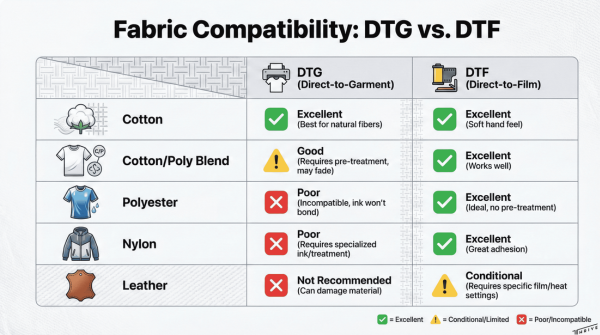
This comparison reveals DTF’s superior substrate versatility, while DTG excels specifically on natural fiber applications requiring premium soft-hand feel.
What Are the Cost Differences Between DTG and DTF Printing?
DTG and DTF printing methods differ significantly in both initial investment and ongoing operational costs. DTG requires substantially higher startup capital but offers premium pricing opportunities, while DTF provides lower entry barriers with cost advantages for volume production. These cost differences directly impact business profitability and market positioning strategies. The following breakdown examines startup costs, production economics, and overall cost-effectiveness for custom apparel businesses.
What Are the Startup and Operating Costs for Each Method?
DTG startup costs range from $20,000 to $250,000+ compared to DTF equipment starting at $5,000 to $15,000+. This represents a 4-17x cost difference in initial equipment investment. Operating costs show similar disparities—DTG ink costs approximately $2-$5 per shirt while DTF costs only $0.10-$0.50 per print.
Key Operating Cost Components:
- DTG requires pre-treatment solution as ongoing consumable
- DTF requires transfer film and adhesive powder as consumables
- DTG maintenance costs are higher due to daily cleaning requirements
- DTF has lower maintenance frequency but requires heat press operations
The dramatic difference in consumable costs makes DTF significantly more economical for businesses planning high-volume production runs.
How Do DTG and DTF Affect Production Costs for Small and Large Orders?
DTG has higher per-print costs due to ink consumption and pre-treatment requirements, making it less economical for large orders. DTF shows lower per-print costs that decrease further with larger quantities due to efficient transfer production. DTG’s strength lies in on-demand single items that command premium pricing without minimum order quantities.
Production Cost Scenarios:
- Small orders (1-10 pieces): DTG premium pricing offsets higher costs
- Medium orders (11-100 pieces): DTF cost advantages become apparent
- Large orders (100+ pieces): DTF significantly outperforms DTG economically
- Rush orders: DTG’s direct printing eliminates transfer preparation time
DTF’s ability to pre-print transfers allows batch processing that reduces labor costs per unit for volume orders.
Which Method Is More Cost-Effective for Custom Apparel Businesses?
DTF often presents lower barriers to entry due to reduced initial equipment costs and potentially leads to faster ROI through higher production speeds for bulk orders. DTF’s lower per-unit costs make it attractive for businesses targeting volume markets. DTG contributes to profitability through premium pricing strategies for single prints and specialized applications on natural fibers.
Business Model Considerations:
- Retail storefronts benefit from DTG’s no-minimum capabilities
- Wholesale operations favor DTF’s volume cost advantages
- DTF equipment payback periods are typically 6-12 months shorter
- DTG commands 2-3x higher margins on premium custom work
The choice depends on target market positioning—DTG for premium, low-volume custom work versus DTF for cost-competitive, higher-volume production. Many successful operations combine both methods to maximize market coverage and profitability across different order types.
How Do DTG and DTF Printing Impact Sustainability and the Environment?
DTG and DTF printing impact sustainability through different environmental factors, with DTG using fewer chemicals than traditional methods while DTF creates plastic waste concerns. Both technologies offer more eco-friendly alternatives to conventional screen printing, though each presents unique environmental challenges requiring careful material choices and waste management practices.
What Are the Environmental Concerns Associated with Each Process?
Environmental concerns associated with each process differ primarily in water usage, chemical disposal, and plastic waste generation. DTG printing uses less water than traditional screen printing methods but requires pre-treatment chemicals that need proper handling and disposal protocols. The pre-treatment process involves alkaline solutions that can be harmful if released into water systems without appropriate treatment.
DTF printing involves PET films and hot-melt adhesive powders, which contribute to plastic waste streams when transfers are applied and backing films are discarded. These materials require specialized disposal methods to prevent environmental contamination. However, the printing industry is actively moving towards recyclable films and eco-friendly powder formulations that reduce plastic waste impact.
Both processes generate consumable waste that requires proper disposal, though DTF’s plastic components present more complex recycling challenges than DTG’s water-based waste products.
How Do Ink and Material Choices Affect Eco-Friendliness?
Ink and material choices significantly affect eco-friendliness, with water-based formulations offering the most sustainable printing options. DTG utilizes water-based inks that are generally more eco-friendly than plastisol inks used in traditional screen printing, producing fewer volatile organic compounds and requiring less harsh cleaning chemicals.
Many DTF inks and films are now OEKO-TEX certified, ensuring freedom from harmful substances such as heavy metals, formaldehyde, and other toxic chemicals. This certification guarantees that printed materials meet human health and environmental safety standards.
Both DTG and DTF use water-based inks as their primary ink type, eliminating the need for petroleum-based solvents found in older printing technologies. These water-based formulations break down more easily in waste treatment systems and produce fewer air pollutants during the printing process, making both methods more environmentally responsible choices for custom apparel production.
What Factors Should You Consider When Choosing Between DTG and DTF Printing?
The factors you should consider when choosing between DTG and DTF printing include order volume, garment materials, skill requirements, and specific business applications. Your decision impacts production efficiency, cost-effectiveness, and print quality outcomes.
How Do Order Size and Garment Type Influence Your Decision?
Order size and garment type determine which printing method delivers optimal results and profitability. DTG excels for small runs and on-demand orders on natural fibers, while DTF performs better for larger batches requiring versatile substrate compatibility.
Key decision factors include:
- Order volume (DTG: 1-50 pieces; DTF: 50+ pieces)
- Material type (DTG: cotton/cotton blends; DTF: any fabric)
- Turnaround time requirements
- Quality expectations versus cost constraints
The DTG market size reached USD 1.92 billion in 2024 and projects growth to USD 3.90 billion by 2030 with 13.0% CAGR, according to industry analysts. In contrast, DTF market data shows 6.2% CAGR from 2024-2030, indicating strong demand for both technologies.
DTG suits businesses prioritizing soft hand feel and premium pricing for custom single pieces. DTF appeals to operations requiring substrate flexibility and faster production cycles for moderate to large quantities.
What Is the Skill Level Required to Operate Each Printing Method?
The skill level required varies significantly between DTG and DTF operations. DTG demands understanding of regular maintenance procedures to prevent clogging, while DTF generally requires less intensive maintenance protocols.
DTG operational requirements:
- Daily print head cleaning and maintenance
- Pre-treatment solution preparation and application
- Color profile management for different fabrics
- Troubleshooting ink flow and curing issues
DTF operational requirements:
- Film handling and powder application techniques
- Heat press temperature and pressure settings
- Transfer timing and peeling procedures
- Quality control for adhesion strength
Industry experts note trends toward hybrid systems performing both DTG and DTF printing functions. Ricoh’s latest printers enable switching between DTG and DTF with a single machine, reducing skill barriers and equipment investments.
The learning curve for DTG typically requires 2-4 weeks for basic proficiency, while DTF operators often achieve competency within 1-2 weeks due to simpler maintenance requirements.
What Are Common Use Cases for DTG and DTF Printing?
Common use cases for each method reflect their distinct strengths and applications. DTG serves short runs, prototypes, and full-color designs requiring soft hand feel, while DTF handles diverse substrates including polyester, nylon, and leather.
DTG applications include:
- Custom retail locations with no minimum order quantities
- Prototype development and sampling
- High-detail photographic reproductions
- Premium custom apparel with soft feel requirements
DTF applications include:
- Pre-printed transfers for faster bulk production
- Multi-material product lines (bags, shoes, technical fabrics)
- Inventory management through transfer stockpiling
- Contract printing services requiring substrate versatility
Businesses successfully implement DTG for retail locations capitalizing on impulse purchases and personalization trends. DTF suits operations managing diverse product catalogs or serving clients with varying material specifications.
The choice between methods often determines business model viability, with DTG enabling premium pricing strategies and DTF supporting volume-based profitability through efficiency gains and material flexibility.
How Can Thrive Screen Printing Help You Decide Between DTG and DTF Printing?
Can Thrive Screen Printing Provide Guidance or Custom Solutions for Your Printing Needs?
Thrive Screen Printing provides comprehensive guidance and custom solutions for all printing needs through their expertise in DTG, DTF, and screen printing technologies. The nationally recognized custom screen printing company based in Phoenix, Arizona offers DTG printing for short runs, prototypes, and full-color designs that require soft hand feel and premium quality.
Thrive’s services extend beyond basic printing to include:
• Screen printing for high-volume production – Large orders requiring efficient bulk processing
• Apparel fulfillment services – Blind shipping and custom packaging for e-commerce businesses
• Professional finishing – Custom clothing tags and relabeling for brand consistency
• Technology partnerships – Collaboration with industry leaders like Brother for cutting-edge DTG equipment
The company’s hybrid approach allows clients to leverage the best printing method for each specific project, whether it’s DTG’s superior quality for custom pieces or screen printing’s efficiency for large volumes. This versatility enables Thrive to guide businesses toward the most cost-effective solution based on order size, substrate type, and quality requirements.
What Are the Most Important Takeaways About DTG vs DTF Printing?
The most important takeaways about DTG vs DTF printing center on matching the technology to your specific business model and production requirements. DTG excels in high-quality, on-demand printing on natural fibers with soft hand feel, making it ideal for custom apparel businesses serving individual customers with no minimum orders.
DTF provides versatility, durability, and cost-effectiveness for a wider range of substrates and larger volumes. This technology works on cotton, polyester, nylon, leather, and various blends while offering lower per-print costs for bulk production.
Key decision factors include:
• Production volume – DTG for small batches, DTF for larger quantities
• Substrate variety – DTG limited to natural fibers, DTF works on diverse materials
• Investment requirements – DTF offers lower entry costs ($5,000-$15,000) versus DTG ($20,000-$250,000+)
• Quality priorities – DTG delivers softer feel, DTF provides enhanced durability
Hybrid systems offering both DTG and DTF capabilities represent significant industry development, allowing businesses to optimize each order for the appropriate technology. The choice ultimately depends on your specific business model, target market, and production requirements rather than a one-size-fits-all solution.

Robert Fisher is the founder and CEO of Thrive Screen Printing and brings extensive experience in the screen printing and fulfillment industry.