


Struggling to achieve crisp, professional prints? You’re likely here because inconsistent print quality, blurry details, or ink bleeding issues have left you frustrated with your screen printing results. We understand the challenge of selecting the proper mesh size can make or break your entire project, and we’re here to guide you through this critical decision with clear, actionable insights.
Screen mesh size is the number of threads per inch (TPI) woven into the mesh fabric that holds your stencil and controls ink flow during the printing process. This fundamental specification determines everything from ink deposit thickness to print resolution, with standard mesh counts ranging from 36 to 408 TPI for different applications. The mesh count you choose directly impacts whether your prints emerge sharp and vibrant or muddy and unprofessional.
TL;DR Summary: Understanding mesh specifications and standards helps you grasp how thread count affects print outcomes. Selecting the right mesh size requires matching ink types to specific mesh counts while considering your design complexity and substrate material. Common mesh sizes vary by application, with textiles typically using 80-110 mesh and specialty effects requiring unique counts. Testing and troubleshooting your mesh selection prevents common problems like blank spots and moiré patterns. Working with experts like Thrive Screen Printing ensures optimal mesh selection for professional results, backed by industry data showing the screen printing market reaching $11.2 billion by 2030.
Quick Tip: When in doubt, start with 110 mesh count for general textile printing—it provides excellent versatility for both light and dark garments while accommodating most standard plastisol inks.
What Is Screen Mesh Size and Why Does It Matter in Printing?
Screen mesh size refers to the number of threads per inch (TPI) or per centimeter (TPC) in the woven fabric used to create printing screens. This measurement directly controls ink flow and print quality in screen printing applications. The mesh acts as a filter that determines how much ink transfers to the substrate and how fine the printed details appear.
Screen mesh selection impacts every aspect of print quality, from ink deposit thickness to image resolution. Lower mesh counts create thicker ink layers suitable for bold graphics, while higher counts enable precise detail reproduction on various substrates. Understanding mesh size fundamentals helps printers achieve consistent results across different projects and ink types. This section explores mesh measurement standards and the relationship between mesh count and print performance.
How Is Mesh Size Measured in Screen Printing?
Mesh count is defined as the number of threads per inch (TPI) or per centimeter (TPC) in the woven mesh fabric. Standard mesh ranges span from 36 to 408 TPI, with 110 and 156 TPI being the most common counts for general applications.
ISO 4783 defines tolerances, designations, and specifications for industrial woven wire mesh globally. ASTM E437 establishes four grades of square mesh based on mesh count and wire diameter. These standards ensure consistency across manufacturers and applications.
Lower mesh counts feature larger openings that allow thicker ink deposits, while higher counts create finer openings for detailed prints. Thread diameter affects both durability and ink flow—thicker threads restrict flow but provide longer screen life.
How Does Mesh Count Affect Print Quality and Ink Deposit?
The relationship between mesh count and ink deposit thickness is inversely proportional. A 110 mesh count provides 50 cm³/m² theoretical ink volume versus 380 mesh at only 16 cm³/m², demonstrating how mesh selection directly controls ink layer thickness.
As mesh count rises above 300 threads per inch, finer images and details can be printed on non-porous materials such as paper and plastics. Proper mesh tension of 40 N/cm achieves significantly better print quality than hand-stretched screens at 1-2 N/cm.
Higher tension allows for reduced off-contact distance, improving registration accuracy and image sharpness. Thread diameter balances durability against ink flow characteristics—thicker threads last longer but may restrict ink passage for fine detail work.
The combination of mesh count, thread diameter, and proper tension creates the foundation for consistent print quality across production runs.
What Factors Should You Consider When Selecting a Screen Mesh Size?
Selecting the right screen mesh size requires evaluating ink type, design complexity, and substrate material. Each factor directly impacts print quality, ink deposit thickness, and production efficiency. These three considerations work together to determine optimal mesh count for any screen printing project.
What Types of Ink Work Best With Different Mesh Sizes?
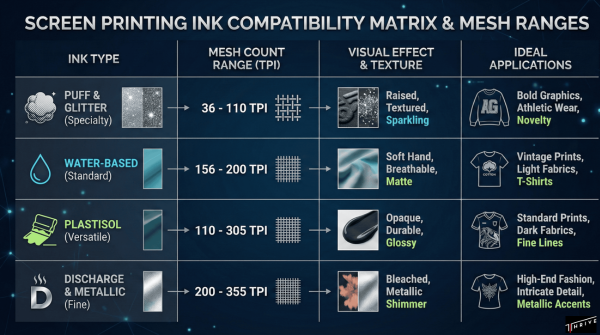
Different ink types require specific mesh sizes based on their viscosity and particle composition. The mesh count must accommodate each ink’s flow characteristics while ensuring proper transfer to the substrate.
| Ink Type | Mesh Count (TPI) | Reason |
| Plastisol | 110 | Thick consistency requires larger openings |
| Water-based | 155-305 | Finer pigments need moderate to fine mesh |
| Discharge | 110-156 | Balances ink flow with chemical activation |
| Glitter | 25-40 | Large glitter particles demand coarse mesh |
| Metallic | 80-86 | Heavy, opaque deposits require larger openings |
| High-density | 30-61 | Creates raised effect with thick ink layers |
| Puff | 110 | Provides sufficient thickness for expansion |
Plastisol inks work best with 110 mesh count due to their thick consistency requiring larger mesh openings. Water-based inks perform optimally with 155-305 mesh because their finer pigments flow through smaller apertures effectively.
How Do Design Details and Artwork Impact Mesh Size Choice?
Design complexity determines the required mesh fineness for accurate reproduction. Fine details demand higher mesh counts, while bold graphics perform better with lower counts.
Fine detail prints require higher mesh counts of 200-305 TPI to capture intricate elements accurately. Halftone printing requires mesh count at least 3.5 times the halftone line count (LPI) to avoid moiré patterns that compromise image quality.
Bold graphics perform best with lower mesh counts of 80-110 TPI because they allow sufficient ink deposit for vibrant, opaque coverage. Using incorrect mesh angle or count for halftones causes moiré pattern defects that create unwanted visual interference.

How Does Substrate Material Influence Mesh Selection?
Substrate porosity and surface characteristics dictate mesh requirements for optimal ink adhesion and coverage. Different materials absorb ink differently, requiring matched mesh selections.
Absorbent fabrics require lower mesh counts (80-110 TPI) for sufficient ink deposit, especially on dark garments where opacity matters. Non-porous substrates like paper or plastic use higher mesh counts (300+ TPI) for fine detail reproduction without excessive ink buildup.
Mesh structure serves as the primary determinant of ink film thickness transferred to substrate during printing. Capillary forces in mesh-substrate interaction can be manipulated to prevent coffee ring effects that create uneven coverage patterns.
The next section explores the most commonly used mesh sizes across different applications and substrates.
What Are the Most Common Mesh Sizes Used in Screen Printing?
Screen printing mesh selection varies by application, with specific counts optimized for different substrates and ink types. The most widely adopted mesh sizes provide reliable results across diverse printing scenarios. Understanding these standard configurations helps printers achieve consistent quality while minimizing setup complications.
Which Mesh Sizes Are Best for Textiles Versus Paper or Plastics?
The most commonly used mesh counts globally are 100, 110, 120, and 140 TPI, accounting for approximately 80% of all screen printing applications. Textiles typically use 80-110 mesh for light-colored inks on dark garments because lower counts allow thicker ink deposits that provide adequate coverage and opacity. Paper and plastics require 300+ mesh count for optimal fine detail printing, as these non-porous substrates need precise ink control to prevent bleeding and achieve sharp edges.
Standard-thread mesh is recommended for over 95% of screen printing jobs due to its balanced durability and ink flow characteristics. The thread diameter in standard mesh provides sufficient strength for repeated squeegee passes while maintaining consistent openings for uniform ink transfer.
Common Mesh Applications by Substrate:
- Cotton/Poly Blends: 86-110 TPI for general graphics
- 100% Cotton: 80-100 TPI for maximum ink deposit
- Coated Papers: 200-280 TPI for halftones
- Plastic Films: 305-355 TPI for fine details
- Corrugated Cardboard: 110-156 TPI for durability
What Mesh Sizes Are Preferred for Specialty Inks or Effects?
Heat-resistant inks for extreme climates use optimized mesh counts based on substrate requirements, with automotive applications typically employing 110-156 mesh to balance thermal stability with adequate ink film thickness. Computer-to-Screen (CTS) systems enable real-time mesh selection optimization by analyzing artwork complexity and automatically recommending appropriate mesh counts for each color separation.
Direct-to-Mesh (DTM) technology eliminates traditional emulsion coating requirements, allowing printers to use specialized mesh configurations that would be incompatible with standard emulsion systems. This advancement enables custom mesh treatments for unique ink formulations and substrate combinations.
Specialty Ink Mesh Requirements:
- Glow-in-the-Dark: 25-40 TPI for phosphorescent particles
- Reflective Inks: 60-86 TPI for glass bead suspension
- Conductive Inks: 200-230 TPI for electronic applications
- Ceramic Glazes: 40-60 TPI for high-temperature firing
These standardized mesh selections provide the foundation for successful screen printing across multiple industries, from basic textile decoration to specialized industrial applications requiring precise ink control and exceptional durability.
How Can You Match the Right Mesh Size to Your Screen Printing Project?
Matching the right mesh size to your screen printing project requires systematic testing and understanding of common failure modes. The mesh selection process involves balancing ink properties, design requirements, and substrate characteristics to achieve optimal print quality.
What Steps Should You Take to Test and Confirm Your Mesh Selection?
The steps to test and confirm your mesh selection include implementing quality control protocols and monitoring key variables throughout production. Begin with ink preparation protocols, as consistent ink viscosity directly affects mesh performance across different counts.
Regular ink stirring prevents pigment separation that can clog mesh openings and create inconsistent deposits. Adjust off-contact distance based on both mesh tension and count—higher mesh counts typically require reduced off-contact to maintain proper ink transfer. Verify ink-fabric compatibility through test prints before full production runs, as some ink formulations perform poorly with specific mesh-substrate combinations.
Monitor mesh tension regularly using a tension meter, as proper tension of 40 N/cm achieves significantly better print quality than hand-stretched screens at 1-2 N/cm. Document successful combinations of mesh count, tension, and off-contact distance for future reference.
What Problems Can Occur From Using the Wrong Mesh Size?
Problems from using the wrong mesh size manifest as print defects that compromise both quality and production efficiency. These issues range from complete print failures to subtle quality degradation that becomes apparent only after production.
Common problems include:
- Blank spots result from poor screen tension, pinholes, or improper emulsion preparation combined with inadequate mesh selection
- Poor detail reproduction occurs when mesh count is too low for the design complexity, causing fine lines to break up or merge
- Ink bleed happens with mesh count too low for the ink viscosity or excessive squeegee pressure overwhelming mesh control
- Moiré patterns appear with incorrect mesh angle or count relative to halftone frequency—mesh count should be at least 3.5 times the halftone line count
- Excessive off-contact distance combined with wrong mesh causes frequent print failures and poor registration
Using 110 mesh for fine detail work results in insufficient resolution, while 300+ mesh with thick plastisol inks creates inadequate opacity and coverage. These mismatches lead to reprints, waste, and extended production times that increase project costs significantly.
The next section explores how Thrive Screen Printing’s expertise helps optimize mesh selection for specific project requirements and substrate combinations.
How Should You Approach Screen Mesh Size Selection With Thrive Screen Printing?
Can Thrive Screen Printing Help You Choose the Ideal Mesh Size for Your Project?
Thrive Screen Printing can help you choose the ideal mesh size for your project through expert consultation and optimized mesh selection. The company operates from a 40,000 square foot facility in Phoenix, Arizona, providing comprehensive mesh optimization services for each printing project.
Thrive Screen Printing uses specific mesh counts based on design requirements:
- Fine designs: 200+ mesh counts for detailed artwork and precise registration
- Bold graphics: 80-110 mesh counts for vibrant, opaque coverage
- Specialty applications: Heat-resistant inks optimized for extreme climates
The company offers contract printing and wholesale services with mesh optimization included in project planning. Their expertise extends to specialty ink applications, ensuring proper mesh selection matches ink viscosity and substrate requirements. This approach eliminates guesswork and reduces production errors that occur from incorrect mesh selection.
Thrive Screen Printing’s technical consultation addresses design complexity, substrate material, and ink type to determine optimal mesh specifications before production begins.
What Are the Key Takeaways About Choosing the Right Screen Mesh Size?
The key takeaways about choosing the right screen mesh size center on matching mesh specifications to project requirements and understanding market economics. Screen printing mesh costs range from $0.92 to $1.65 per square meter, making proper selection crucial for project profitability.
Market Growth and Investment Considerations:
| Screen Printing Market Segment | Key Metric | Market Value | Data Source |
| Global screen printing mesh market | 2024 Value | USD 748.47 million | Market Research |
| Global screen printing mesh market | 2032 Projection | USD 1,085.77 million | Market Research |
| Market Growth Rate | CAGR | 4.76% | Market Research |
| Asia-Pacific Region | Market Share | 35% | Market Research |
| North America Region | Market Share | 25% | Market Research |
| Overall Screen Printing Market | 2030 Projection | $11.2 billion | Industry Analysis |
Essential Selection Principles:
- Match mesh count to ink type and design complexity first
- Consider substrate absorption properties when selecting mesh openings
- Factor in production volume and mesh replacement costs
- Verify mesh tension requirements for consistent print quality
The growing market indicates increased demand for specialized mesh solutions, making proper selection knowledge essential for competitive printing operations. Understanding these market dynamics helps inform equipment investments and mesh inventory planning for optimal project outcomes.

Robert Fisher is the founder and CEO of Thrive Screen Printing and brings extensive experience in the screen printing and fulfillment industry.